What Is Event Gamification?
Event gamification is the practice of applying game mechanics — points, leaderboards, challenges, badges, and rewards — to event experiences to drive attendee engagement, participation, and interaction. It transforms passive attendees into active participants by tapping into the same psychological drivers that make games compelling: achievement, competition, and social recognition.

In 2026, gamification has evolved far beyond simple “scan this QR code” contests. Modern event platforms now integrate AI-powered gamification that adapts to attendee behavior in real time, personalizes challenges based on profiles, and provides organizers with granular data on which activities drive the most engagement.
The Psychology Behind Event Gamification
Gamification works because it activates three core psychological drivers that humans are wired to respond to:
The Dopamine Loop
Every time an attendee earns points, unlocks a badge, or climbs a leaderboard, their brain releases dopamine — the neurotransmitter associated with pleasure and reward. This creates a positive feedback loop: complete action → get reward → feel good → seek next action. It’s the same mechanism that makes social media feeds and mobile games addictive, but applied constructively to event engagement.
Achievement Motivation
Research by psychologist David McClelland identified achievement motivation as a fundamental human drive. People are naturally drawn to tasks with clear goals, measurable progress, and defined outcomes. Gamification provides exactly this — turning abstract “attend sessions and network” into concrete “complete 5 challenges and earn your Explorer badge.”
Social Proof and Competition
Public leaderboards leverage social comparison theory. When attendees see peers earning points and climbing rankings, it creates a subtle (or not-so-subtle) competitive pressure to participate. This is especially effective at conferences where professionals are naturally motivated by status and recognition among their peers.
12 Proven Event Gamification Strategies
1. Leaderboard and Points System
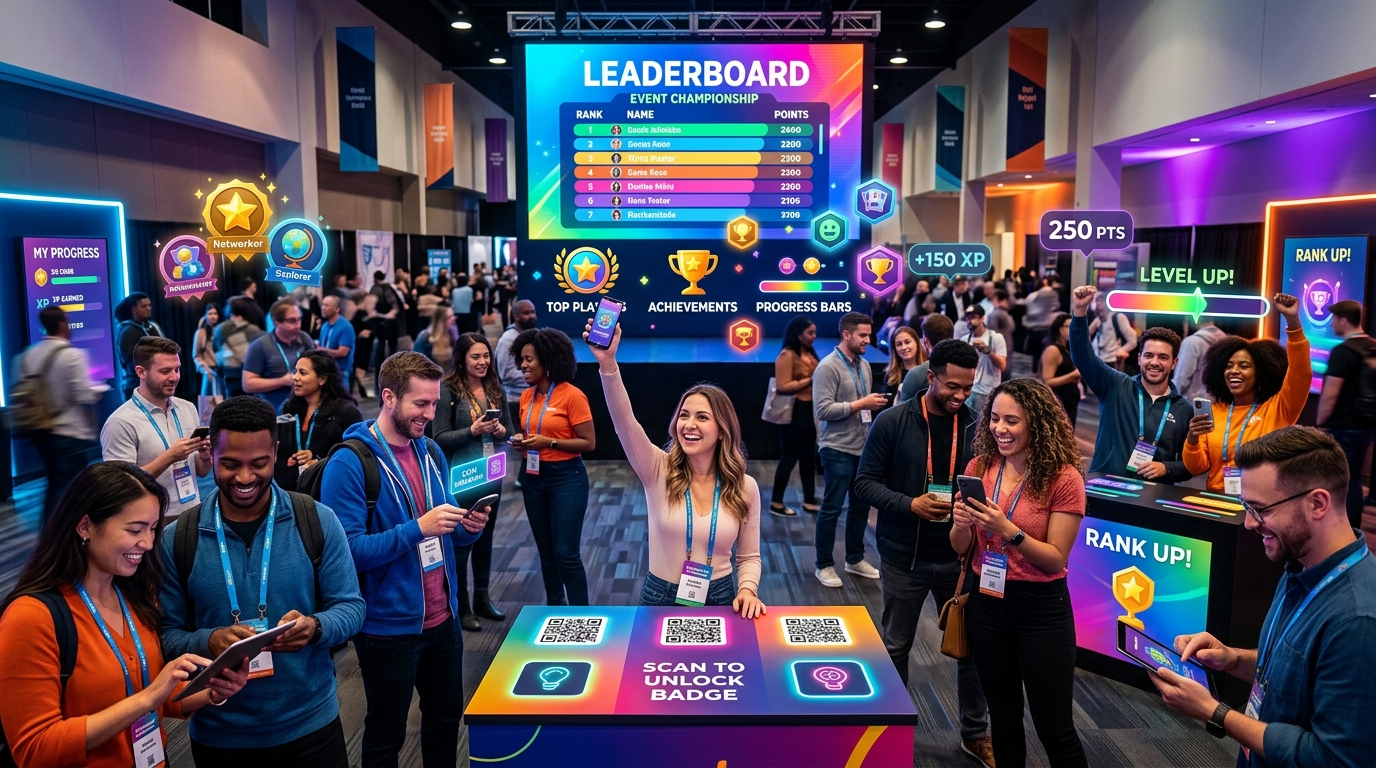
How it works: Assign point values to key event activities — attending sessions (10 pts), visiting sponsor booths (15 pts), networking with new people (20 pts), posting on social media (5 pts), answering poll questions (5 pts). Display a live leaderboard on screens throughout the venue and in the event app.
Why it works: Leaderboards are the backbone of event gamification because they combine three motivators simultaneously: achievement (accumulating points), competition (outranking peers), and recognition (seeing your name on the board).
Implementation tip: Keep the leaderboard visible but not overwhelming. Display the top 10-20 participants on main stage screens between sessions, and let all attendees check their rank in the event mobile app. Award prizes at the closing ceremony to the top 3.
2. QR Code Scavenger Hunts
How it works: Place QR codes at strategic locations throughout the venue — sponsor booths, breakout rooms, registration desk, food stations, outdoor areas. Attendees scan codes with the event app to collect points, unlock clues, or reveal hidden content. The first to scan all codes wins.
Why it works: Scavenger hunts solve the perennial problem of getting attendees to explore the full venue. Instead of clustering around the main stage and coffee area, attendees have a reason to visit sponsor booths, check out demo areas, and explore spaces they’d normally skip.
Implementation tip: Design the scavenger hunt so it’s impossible to complete without visiting at least 3-4 sponsor booths. This is a massive value-add for sponsors and can justify premium sponsorship pricing. Use the check-in system to track booth visits automatically.
3. Session Check-In Challenges
How it works: Award points when attendees check into sessions using QR codes or NFC. Create bonus challenges like “attend sessions in 3 different tracks” or “attend all keynotes” to encourage exploration beyond an attendee’s comfort zone.
Why it works: Session attendance is the primary metric that sponsors and speakers care about. Gamifying session check-ins increases attendance rates across all tracks — especially breakout sessions and workshops that often suffer from low turnout.
Implementation tip: Combine session check-in with a quick 2-question quiz about the session content (delivered via the app 5 minutes before the session ends). This proves genuine attendance, not just “badge swipe and leave.”
4. Networking Bingo
How it works: Give each attendee a digital bingo card (in the event app) with prompts like “Find someone who works in AI,” “Meet someone from a different continent,” “Connect with a speaker,” “Exchange info with 3 people from different companies.” Completing a row or full card earns rewards.
Why it works: Networking is the #1 reason professionals attend conferences, yet most people struggle to break the ice with strangers. Bingo cards give attendees a structured excuse to approach people they wouldn’t normally talk to — “Hi, I need to find someone who works in healthcare for my bingo card” is a much easier opener than “Hi, what do you do?”
Implementation tip: Integrate with AI-powered networking tools so the bingo prompts are personalized based on attendee profiles. Someone in fintech gets “Find someone who works in RegTech” rather than generic prompts.
5. Social Media Photo Challenges
How it works: Create Instagram/LinkedIn-worthy photo challenges tied to the event — “Post a selfie with a speaker,” “Capture the best food station photo,” “Show your event badge in a creative way.” Award points for posts using the event hashtag, verified through the AI Photo Gallery.
Why it works: Social media challenges extend your event’s reach far beyond the venue. Every attendee post is organic marketing that reaches their professional network. A 1,000-person conference where 200 attendees post generates thousands of impressions among their connections.
Implementation tip: Display a live social media wall at the venue showing posts with the event hashtag. This creates a visible social proof loop — attendees see others posting, which motivates them to post too.
6. Sponsor Booth Quests
How it works: Work with sponsors to create mini-challenges at their booths — watch a product demo (15 pts), answer a trivia question about the sponsor’s product (10 pts), scan a QR code and submit a business card for a prize draw (20 pts). Create “quest chains” that require visiting 3+ sponsor booths.
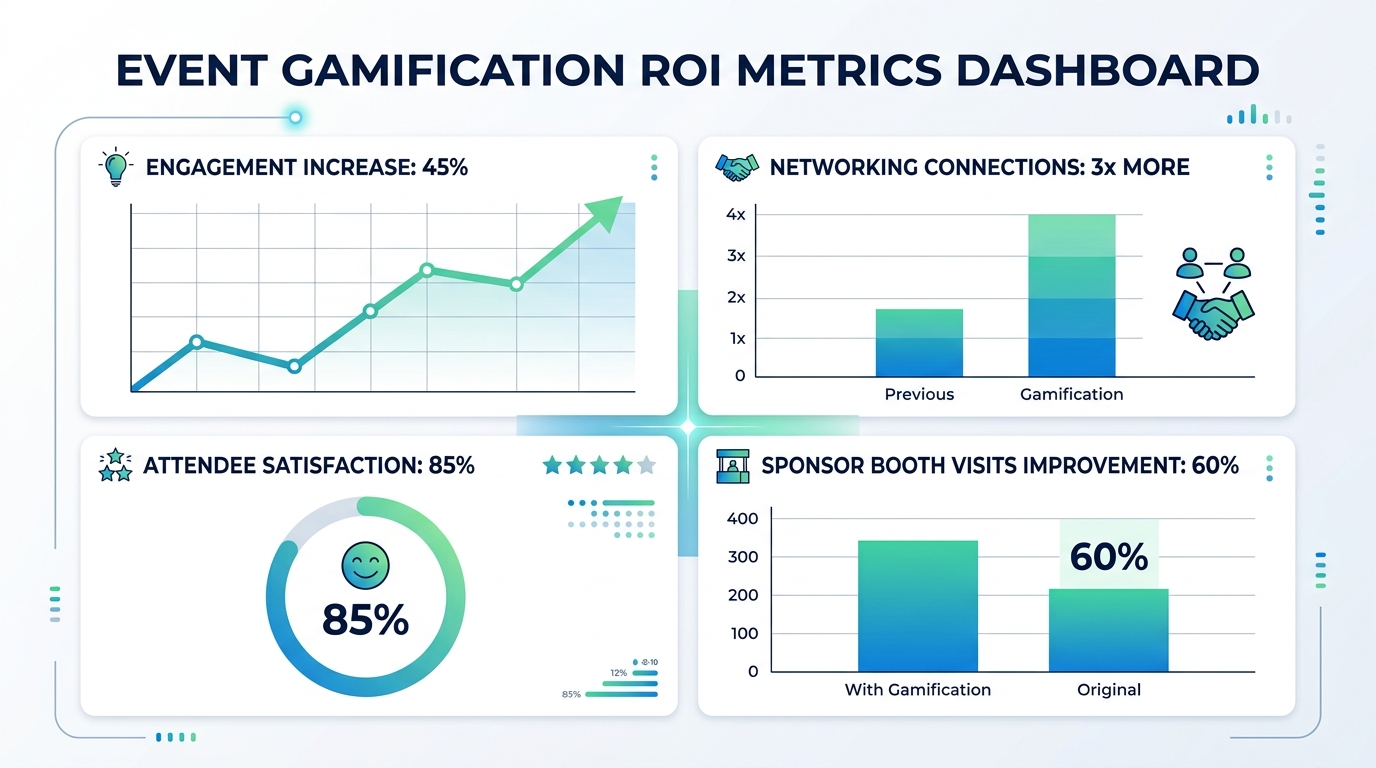
Why it works: This directly addresses the biggest sponsor complaint: “Nobody visited our booth.” Gamified booth visits increase foot traffic by 40-60% according to industry benchmarks. It also transforms boring booth visits into interactive experiences.
Implementation tip: Create tiered sponsor quests — Gold sponsors get higher-point challenges and exclusivity. This creates a quantifiable ROI story for sponsor renewals: “Your booth had 347 completed quest interactions.”
7. Live Quiz Competitions
How it works: Run Kahoot-style live quizzes during sessions, between keynotes, or at networking breaks. Questions can relate to session content, industry knowledge, or fun facts about the event city. Display results on the main stage screen for maximum energy.
Why it works: Live quizzes create high-energy moments that break up the “sit and listen” monotony of traditional conferences. They’re also effective knowledge retention tools — research shows that testing immediately after learning increases retention by up to 50%.
Implementation tip: Use live polling and Q&A tools to run quizzes seamlessly within the event app. Keep quizzes to 5-7 questions maximum and run them during natural transition moments (session breaks, post-lunch).
8. Achievement Badges and Milestones
How it works: Create a set of digital badges that attendees unlock based on activities: “Early Bird” (first to check in), “Social Butterfly” (connected with 10+ people), “Knowledge Seeker” (attended 5+ sessions), “Explorer” (visited all venue zones), “VIP” (attended exclusive events). Display badges on attendee profiles in the event app.
Why it works: Badges provide recognition without requiring direct competition. Not everyone is motivated by leaderboards, but most people enjoy collecting achievements. Badges also create a sense of completionism — “I have 6 of 8 badges, I need to visit the Innovation Zone to get the Explorer badge.”
Implementation tip: Design visually appealing badges that attendees will want to share on LinkedIn. Include surprise “hidden” badges that unlock for unexpected actions — this creates buzz as attendees discuss what triggers the secret badges.
9. Referral Reward Programs
How it works: Give registered attendees a unique referral code. For every new registration through their code, both the referrer and the new registrant earn rewards — discounts on future events, premium session access, or gamification bonus points.
Why it works: Referral gamification drives registrations while leveraging the most powerful marketing channel: word of mouth. A referred attendee is 37% more likely to attend (they know someone there) and 18% less likely to no-show.
Implementation tip: This works best as a pre-event gamification strategy. Start the referral program 4-6 weeks before the event and track referrals through the registration platform. Display a “Top Referrers” leaderboard in the event app.
10. Polling and Prediction Contests
How it works: Run prediction contests tied to event content — “Who will win the startup pitch competition?”, “What will the keynote speaker’s top recommendation be?”, “Predict this afternoon’s workshop attendance numbers.” Award points for correct predictions.
Why it works: Prediction contests keep attendees mentally engaged with event content beyond just passively listening. They also generate interesting data for organizers — attendee predictions can be shared on stage as audience sentiment indicators.
Implementation tip: Combine with live polling to run predictions in real-time. Share results on stage: “72% of you predicted correctly!” This creates memorable shared moments.
11. Early Bird Engagement Rewards
How it works: Start gamification before the event begins. Award points for completing pre-event activities: filling out your attendee profile (10 pts), uploading a photo (5 pts), selecting sessions for your agenda (15 pts), connecting with 3 attendees in the app (20 pts), sharing the event on social media (10 pts).
Why it works: Pre-event gamification solves the “empty app” problem. Most event apps launch with minimal attendee activity, creating a poor first impression. By gamifying profile completion and early networking, you ensure the app is active and populated before day one.
Implementation tip: Send gamification nudges via email and push notifications 2 weeks before the event. “You’re ranked #47 — complete your profile to jump to the top 20!” This drives app adoption before attendees arrive.
12. Knowledge Test Certifications
How it works: Offer post-session quizzes that attendees can complete to earn a “certification” for that topic. Aggregate certifications into a conference completion certificate: “Completed 8/10 sessions with passing quiz scores — Certified Event Tech Professional 2026.”
Why it works: Certifications add tangible professional value beyond networking and learning. Attendees can add event certifications to their LinkedIn profiles, which extends the event’s brand visibility and gives attendees a concrete takeaway to justify event attendance to their employer.
Implementation tip: Partner with industry associations to make certifications count toward continuing education (CE/CPD) credits. This transforms gamification from “fun addition” to “professional development requirement.”
How to Set Up Event Gamification: A Step-by-Step Guide
Step 1: Define Your Gamification Goals
Before choosing game mechanics, clarify what behavior you want to drive. Common gamification goals include: increasing session attendance, driving sponsor booth traffic, improving networking participation, boosting social media mentions, and encouraging app adoption. Pick 2-3 primary goals — gamifying everything creates noise, not engagement.
Step 2: Select Your Game Mechanics
Match game mechanics to your goals. Want more sponsor booth visits? QR scavenger hunts and booth quests. Want better networking? Bingo cards and AI-matched challenges. Want higher session attendance? Check-in challenges and knowledge quizzes. Don’t use all 12 strategies — pick 3-5 that align with your specific event goals.
Step 3: Set Up Your Gamification Platform
Use an event management platform with built-in gamification features. EventHex’s gamification module includes leaderboards, point systems, badge systems, and challenge management — all integrated with check-in, session tracking, and the attendee mobile app. Avoid using separate gamification tools that don’t integrate with your core event platform.
Step 4: Create Compelling Prizes and Rewards
Prizes drive participation. Best-performing prize categories: tech gadgets (AirPods, portable chargers), experience upgrades (VIP dinner, backstage access, speaker meet-and-greet), professional value (free pass to next event, consultation with keynote speaker), and branded merchandise (premium swag, limited-edition items). Budget 1-3% of your event budget for gamification prizes.
Step 5: Launch, Monitor, and Adjust in Real-Time
Go live with gamification at least 1 week before the event (for pre-event engagement). During the event, monitor participation rates in your event analytics dashboard. If a specific challenge has low participation, send a push notification reminder or increase its point value. Announce leaders throughout the day to maintain momentum.
Measuring Gamification ROI: Key Metrics
Gamification is only valuable if you can measure its impact. Track these metrics:
| Metric | What It Measures | Target Benchmark |
|---|---|---|
| Participation rate | % of attendees who engaged with gamification | 40-60% of total attendees |
| Session attendance lift | Increase in session attendance vs. non-gamified events | 15-25% improvement |
| Sponsor booth visits | Completed booth quests / total attendees | 3+ booths per attendee |
| App adoption rate | % of attendees who actively use the event app | 70%+ active users |
| Networking connections made | New connections facilitated through gamification | 5+ per attendee |
| Social media impressions | Reach generated by attendee social posts | 10x attendee count |
| NPS improvement | Net Promoter Score lift vs. non-gamified events | +8-15 points |
| Sponsor satisfaction | Sponsor rating of lead quality from gamified interactions | 4+ out of 5 |
Common Gamification Mistakes to Avoid
Making It Too Complex
If attendees need a tutorial to understand your gamification system, you’ve already lost. The best gamification is intuitive — open the app, see points accumulating, check the leaderboard, done. Limit yourself to one point system, one leaderboard, and 8-12 achievable challenges.
Gamifying Everything
Not every event interaction should earn points. Gamifying restroom visits, food breaks, and basic check-in creates noise and devalues meaningful activities. Focus gamification on the behaviors you genuinely want to encourage: session attendance, networking, and sponsor engagement.
Forgetting About Prizes
A leaderboard without meaningful prizes is just a scoreboard that nobody cares about after the first hour. Budget for real prizes that attendees want. The prize announcement should happen on the main stage during the closing ceremony — this public recognition is as motivating as the prize itself.
Ignoring the Non-Competitive Crowd
Not everyone is motivated by competition. About 40% of attendees prefer collaborative or personal achievement goals over leaderboard rankings. Include both competitive elements (leaderboards) and personal achievement elements (badges, certifications) to engage different personality types.
No Real-Time Feedback
If attendees earn points but don’t see immediate feedback, engagement drops fast. Every action should produce instant visual confirmation — a notification, a point animation, a badge unlock. Delayed gratification doesn’t work in gamification.
How EventHex Gamification Works
EventHex’s built-in gamification module is designed to make gamification setup fast and measurement easy. Here’s what it includes:

- Points Engine: Assign custom point values to any event activity — session check-ins, booth visits, networking connections, social shares, app interactions
- Live Leaderboard: Real-time leaderboard displayed in the mobile app and embeddable on venue screens
- Badge System: Create custom badges with visual designs, unlock criteria, and milestone thresholds
- Challenge Manager: Build multi-step challenges (scavenger hunts, quests, bingo cards) with QR code and NFC integration
- Push Notifications: Automated engagement nudges when attendees are close to earning rewards or falling behind
- Analytics Dashboard: Track participation rates, top activities, engagement patterns, and sponsor booth performance in the event analytics dashboard
- Mobile App Integration: All gamification features are native to the EventHex mobile app — no separate downloads or third-party tools required
The key differentiator is integration. Because gamification is built into the same platform as check-in, session management, and networking, every attendee action is automatically tracked and scored — no manual syncing between separate tools.
Frequently Asked Questions
How much does event gamification cost?
Costs vary by approach. If you use an event platform with built-in gamification (like EventHex), gamification is included in the platform subscription — no additional cost beyond prize budget. Standalone gamification tools typically charge $500-$5,000 per event. Budget 1-3% of your total event budget for prizes and rewards.
Can you gamify virtual events?
Absolutely. Virtual event gamification works through digital leaderboards, online scavenger hunts (finding hidden elements on virtual platforms), quiz competitions, social media challenges, and networking bingo. Virtual gamification is actually easier to track since all interactions are digital by default.
What gamification works best for conferences?
For professional conferences, the most effective combination is: leaderboards with points for session attendance + networking bingo + sponsor booth quests + achievement badges. Keep it professional — avoid overly playful mechanics that might feel out of place at a business event.
How do you measure gamification success?
Track five core metrics: participation rate (% of attendees who engage), session attendance lift compared to non-gamified events, sponsor booth visit count, app adoption rate, and post-event NPS score. Compare these metrics against your previous event to quantify the impact.
Does gamification work for corporate events?
Yes, when done tastefully. Corporate events benefit most from team-based gamification (department competitions), knowledge challenges (quiz competitions around event content), and networking bingo. Avoid overly competitive individual leaderboards at internal corporate events — team-based competition is better received.
What prizes work best for event gamification?
Top-performing prizes: tech gadgets (AirPods, portable chargers, smart speakers), experience upgrades (VIP access, speaker dinners), professional development (free pass to next event, online course subscriptions), and exclusive branded merchandise. Cash prizes feel transactional — experiential and tech prizes generate more excitement.
Conclusion
Event gamification in 2026 isn’t about adding gimmicks — it’s about strategically using game mechanics to drive the engagement, networking, and sponsor interactions that define a successful event. The 12 strategies in this guide work because they’re built on proven psychological principles and can be measured with real data.
Start with 3-5 strategies that align with your specific goals, budget for meaningful prizes, and use a platform with built-in gamification so tracking and measurement happen automatically. The events that master gamification don’t just have higher engagement scores — they have attendees who actively want to come back next year.
Ready to gamify your next event? Explore EventHex’s gamification features or book a demo to see it in action.