
Imagine this: months of meticulous planning, endless negotiations, and hundreds of hours of design work have finally culminated in your annual flagship event. The venue is packed, the atmosphere is electric, and key speakers are on stage. Suddenly, the power cuts out, or an unexpected medical emergency occurs in the main hall. In a split second, the difference between a controlled, highly professional response and absolute, chaotic disaster comes down to one single administrative tool: your on-site event emergency checklist.
For modern event professionals, on-site safety is not just a regulatory compliance box to check; it is the cornerstone of operational resilience. Managing risk under pressure is one of the greatest administrative challenges in live events, where split-second decisions must be backed by pre-planned, reliable systems. When a crisis strikes, there is no time to debate chain of command or search for emergency contact details. This comprehensive guide outlines the 10 vital items every event safety coordinator and organizer must have in their on-site event emergency checklist to protect attendees, minimize liability, and ensure flawless execution even in the face of unexpected adversity.
1. Up-to-Date Incident Response Protocol (IRP)
An Incident Response Protocol is your strategic playbook for any crisis, detailing step-by-step procedures for scenarios such as active shooters, fire hazards, natural disasters, or severe structural failures. It clearly defines the chain of command, ensuring every staff member knows who has the authority to make critical decisions, such as ordering an evacuation or calling a show-stop.
To implement this effectively, the IRP must be localized to the venue’s specific layout and egress routes. It should include maps marking safe assembly points, shelter-in-place locations, and shut-off valves for main utilities. Crucially, this document must be reviewed and signed off by local authorities, such as the fire marshal and local police department, prior to event day to align with local municipality standards.
2. Dedicated Medical Kits and Emergency Equipment
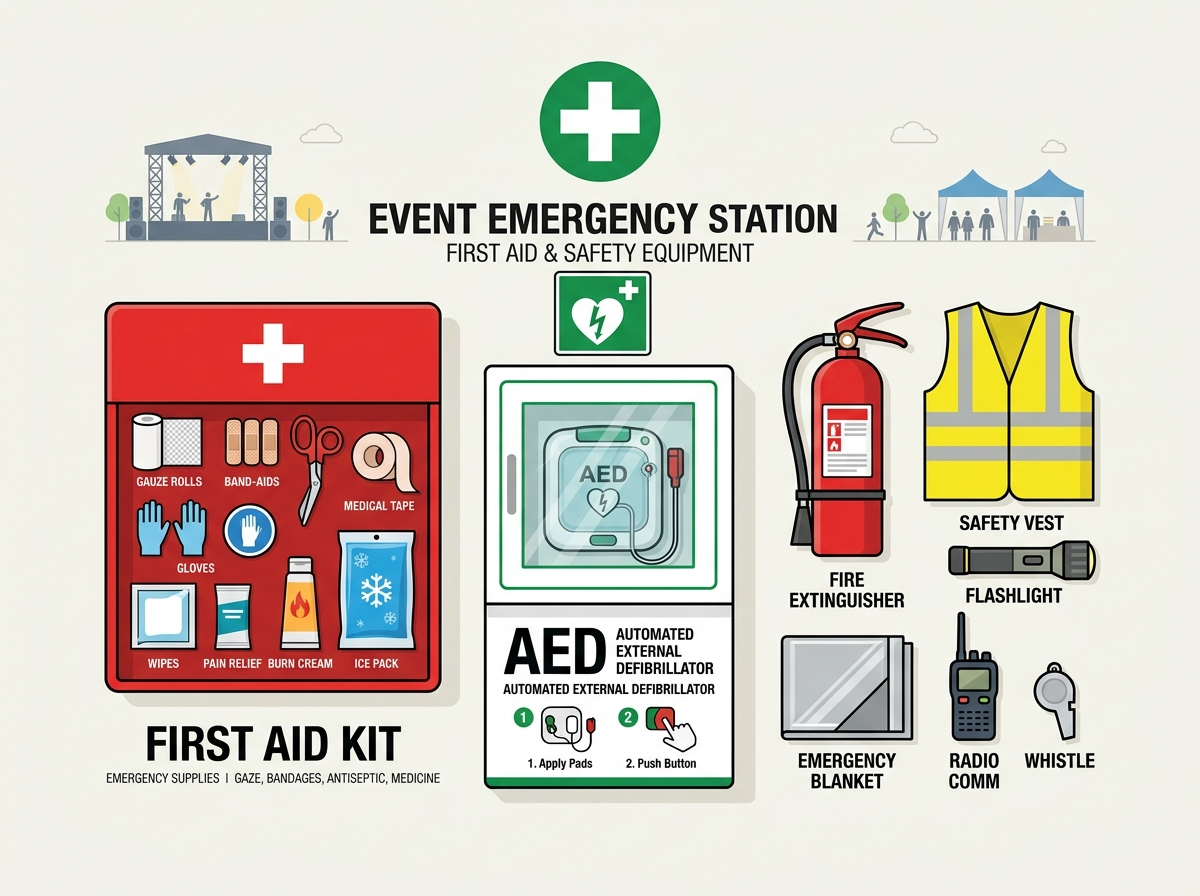
Immediate access to medical equipment is paramount. Depending on the size of your event, a standard first aid kit is rarely enough. Your physical event emergency checklist must verify that multiple, fully stocked trauma kits, bandages, splints, and personal protective equipment are placed in high-visibility locations across the venue.
Most importantly, ensure that Automated External Defibrillators (AEDs) are checked, fully charged, and placed in clearly signed, accessible areas. If you are hiring professional Emergency Medical Services (EMS) personnel or private paramedics, confirm their staging area is completely clear of obstacles, with direct, unhindered access to the main venue floor and the street for ambulance evacuation.
3. Redundant Communication Systems (The Multi-Channel Plan)
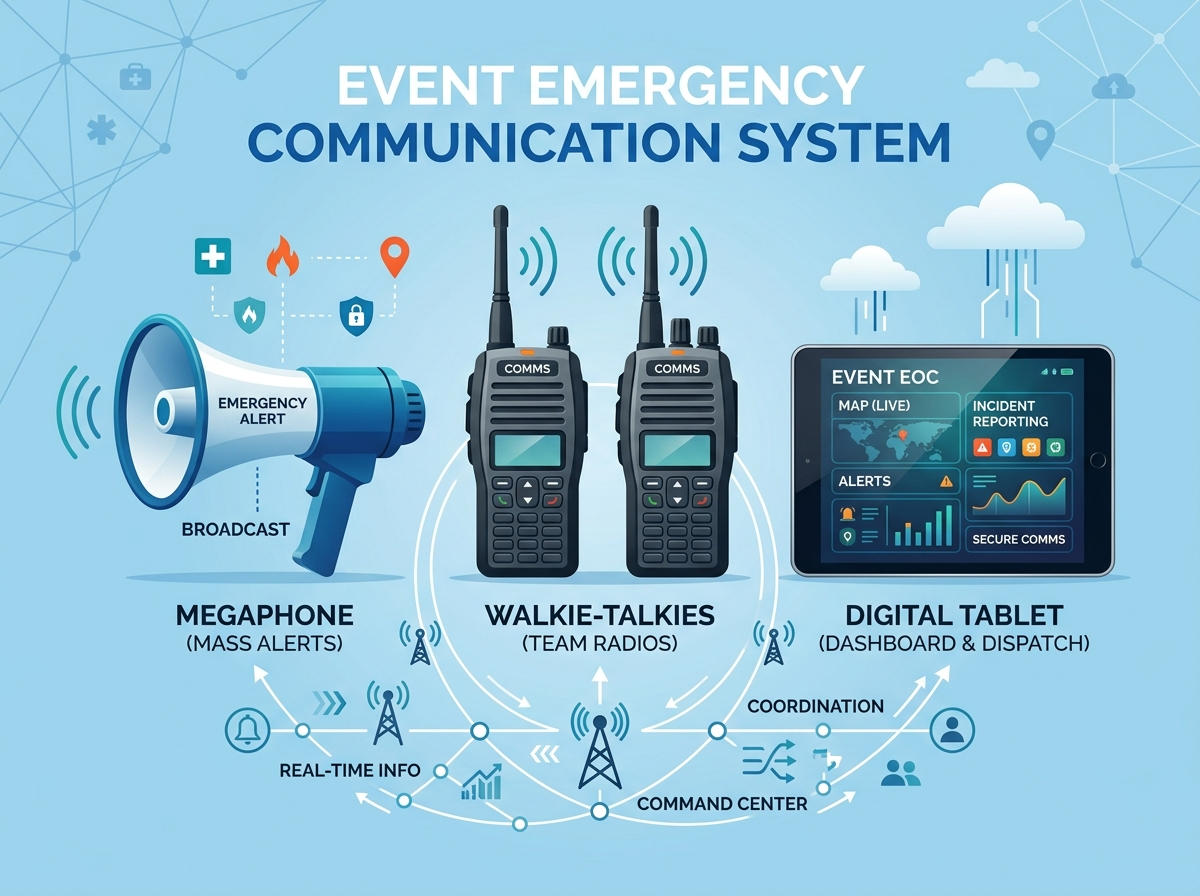
Cellular networks are notorious for collapsing during large-scale public events due to extreme band congestion. Relying solely on mobile phones or messaging apps is a dangerous operational risk. Your checklist must include a robust, redundant communication plan that ensures instantaneous contact between key organizers, security personnel, venue staff, and medical teams.
This plan should feature dual-band walkie-talkies with dedicated channels for security, medical, and AV production teams. Additionally, pre-plan clear “show-stop” procedures and code words that can be delivered securely over radios or the main PA system without inciting panic among attendees. Regular testing of these systems should take place on-site several hours before the gates open to identify dead zones within the venue.
4. Authorized Contact Sheets and Emergency Directory
When an emergency happens, nobody should be searching through an email thread or contact database to find the phone number of the local electric utility, the venue’s head of engineering, or the on-duty police sergeant. A physical and digital contact directory must be printed and distributed to every team leader.
This document should include immediate contacts for venue management, local emergency services (non-emergency lines as well as 911 dispatch), key sponsors, legal counsel, and public relations representatives. Ensuring that these numbers are pre-programmed into critical team members’ phones and laminated in physical kits is an essential on-site safety protocol.
5. Evacuation and Egress Route Signage & Clearance
An evacuation plan is only as good as the physical ability of your crowd to escape. A critical administrative task on the morning of the event is to physically walk the venue’s designated egress pathways. Ensure that all fire exits are unlocked, unobstructed by AV equipment, staging, or signage, and that illuminated “EXIT” signs are completely operational.
For large-scale events, establish a clear barrier plan. Temporary crowd control barriers must be positioned such that they can be quickly moved or opened to prevent crushing and allow rapid, orderly evacuation. Check that ADA-compliant pathways are wide enough and completely clear of electrical cables or structural debris.
6. Crowd Density Monitoring & Capacity Management
Exceeding the venue’s maximum occupancy load calculated by the local fire marshal (NFPA 101 standards) is a major hazard and a serious compliance failure. The on-site checklist must mandate continuous monitoring of crowd density, particularly at bottlenecks like entrances, registration desks, and narrow corridors.
Using digital tracking, gate counts, or smart registration systems can help you monitor live capacity. Staff must be positioned at key intersections to manage crowd flow, implement queue lines, or direct attendees to underutilized sections of the venue to prevent crowd crush incidents.
7. Power Backup and Utility Safety Control Plan
A sudden power failure can plunge a venue into absolute darkness, immediately increasing the risk of slips, trips, falls, and mass panic. Your on-site event emergency checklist must verify the availability and functionality of emergency backup generators, especially for essential systems like emergency lighting, exit signs, and the public address (PA) system.
Event engineers must test the transition to generator power under load before the event. Furthermore, locate and clearly label all main utility shut-off controls—such as electrical breaker panels, water main valves, and gas valves—and ensure only trained, authorized personnel have access to them.
8. Weather and Site Condition Safety Plan
For outdoor or semi-outdoor events, environmental conditions are a constant variable. A strict weather monitoring routine is vital. The safety director should review the National Weather Service (NWS) forecast starting 48 hours prior to the event, with live updates every hour on event day.
For wind-sensitive temporary structures like stages, tents, and rigging, set exact wind thresholds where operations must be modified or suspended. If lightning is detected within a specific radius (typically 8 miles), the on-site team must immediately execute the pre-arranged lightning safety protocol and move attendees to permanent, fully enclosed shelters.
9. Missing Child and Vulnerable Person Protocol
In the chaos of large gatherings, children, elderly attendees, or individuals with special needs can easily become separated from their groups. Having a formalized, rapid-response plan (such as “Code Adam” or similar standardized protocols) ensures that the entire venue is mobilized immediately when a separation is reported.
This protocol must include locking down or monitoring all primary exit points, broadcasting a description of the missing person to all staff radio channels, and coordinating with venue security to search designated zones systematically. The protocol should also define a safe, secure central location where lost individuals can wait under professional supervision while their guardians are located.
10. Public Relations & Crisis Communication Protocol
In the digital age, news of an incident can spread on social media within seconds, often accompanied by rumors or misinformation that can damage your brand’s reputation and hinder emergency responses. Your checklist must include a pre-defined crisis communication plan that controls the narrative with accurate, calm, and timely updates.
Designate a single, trained spokesperson who is authorized to speak to the press and public. Prepare draft media templates and press release outlines in advance, leaving placeholders for specific details of the incident. Under no circumstances should unauthorized staff make public statements or speculate on social media about the cause of an emergency.
Transitioning from Paper Chaos to Digital Safety
Executing an on-site event emergency checklist manually using paper clipboards and verbal updates is a recipe for catastrophic oversight. In high-pressure situations, physical sheets get lost, communication lags, and team leaders operate in information silos. True event resilience requires a centralized, real-time approach to event operations.
This is where EventHex transforms how event professionals approach safety and risk management. As an all-in-one modern event management platform, EventHex replaces the fragmented chaos of spreadsheets and paper forms with a powerful, integrated solution. By leveraging its centralized dashboard, event planners can coordinate safety protocols, track compliance checklists, and monitor real-time event flow in one cohesive space.
From streamlined event registration that prevents overcrowding at venue entry points to real-time communication tools that keep your on-site teams fully synchronized, EventHex ensures your safety director is never left in the dark. Transitioning your checklists into digital, collaborative workflows guarantees that critical safety checkpoints are checked off, documented, and fully auditable, offering unparalleled peace of mind to organizers, venue owners, and local authorities alike.
Frequently Asked Questions
Who is responsible for the on-site event emergency checklist?
The Designated Event Safety Director or Safety Coordinator has primary responsibility for creating, updating, and executing the checklist. However, the entire event management team, including security, medical, and AV teams, must be trained on their specific roles within the checklist.
How often should an event emergency checklist be updated?
Your checklist should be treated as a living document. It must be updated before every single event to reflect the unique layout of the venue, local jurisdictional regulations, specific weather forecasts, and the exact attendance volume.
Why is a paper checklist insufficient for modern event safety?
Paper checklists cannot provide real-time updates, are easily lost or damaged in a crisis, and do not allow for collaborative tracking among distributed teams. Digital tools, such as the centralized dashboard offered by EventHex, ensure absolute transparency, instant communication, and automated data logging for post-event liability reviews.