
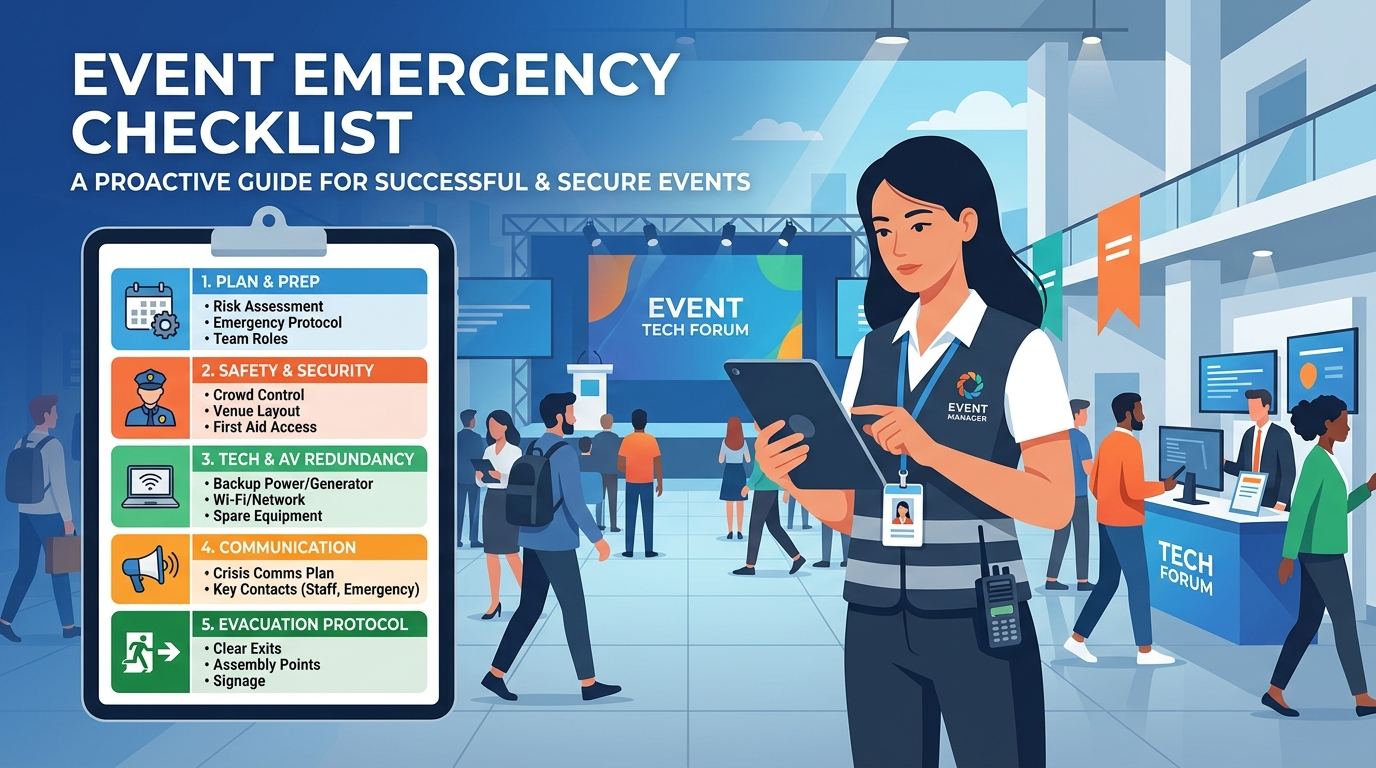
Why You Need a Response Plan Before Event Day
When something goes wrong at a live event, the first question is rarely about equipment. It is who is in charge, who calls the emergency services and how that message reaches every team member when phone networks are jammed. An event emergency response plan answers those questions before the doors open, so nobody has to debate roles in the middle of a crisis.
This guide focuses on the response side of event safety: a clear chain of command, a single operations center, a communication plan that survives network failure and a directory of local responders. Each of the ten items below supports one of those. If you want the quick-reference list of supplies, see our on-site event emergency checklist.
Understanding On-Site Risk Dynamics
Live events are fundamentally complex systems where physical logistics, technological infrastructure, vendor timelines, and crowd behavior collide in real time. Because of this complexity, failure modes are rarely linear. A single point of failure—such as a key staff member being delayed, a temporary router losing power, or a primary power cable being accidentally severed—can trigger a cascade of secondary failures across your entire venue. Without pre-designed operational systems and physical recovery tools, these failures can rapidly turn from minor logistical delays into full-blown safety incidents.
The goal of an effective emergency plan is not simply to document how to evacuate the building in an extreme crisis; it is to build a reliable operational cushion that absorbs minor shocks and resolves unexpected issues before they can escalate into emergencies. Let’s explore the ten fundamental categories of emergency readiness that every professional planner must keep fully integrated into their on-site operations toolkit.
1. Up-to-Date Incident Response Protocol (IRP)
When an emergency occurs, there is no time to debate who is in charge or who should make the final call. An Incident Response Protocol (IRP) is a highly organized, single-sheet document that details exactly what constitutes an emergency, who has the executive authority to pause or cancel the event, and the sequential steps to execute an evacuation. Your IRP must specify critical decision-makers, designate a physical or virtual Event Operations Center (EOC), and outline clear escalation pathways. Having this protocol clearly printed, laminated, and distributed ensures your team acts as a unified unit during high-stress situations.
Furthermore, your IRP should clearly define a communication matrix for external authorities. It must state precisely who is designated to contact local police, medical responders, or fire departments, thereby eliminating duplicate or confusing calls that can delay response times. Keeping this protocol updated and rehearsed ensures absolute operational discipline when pressure rises.
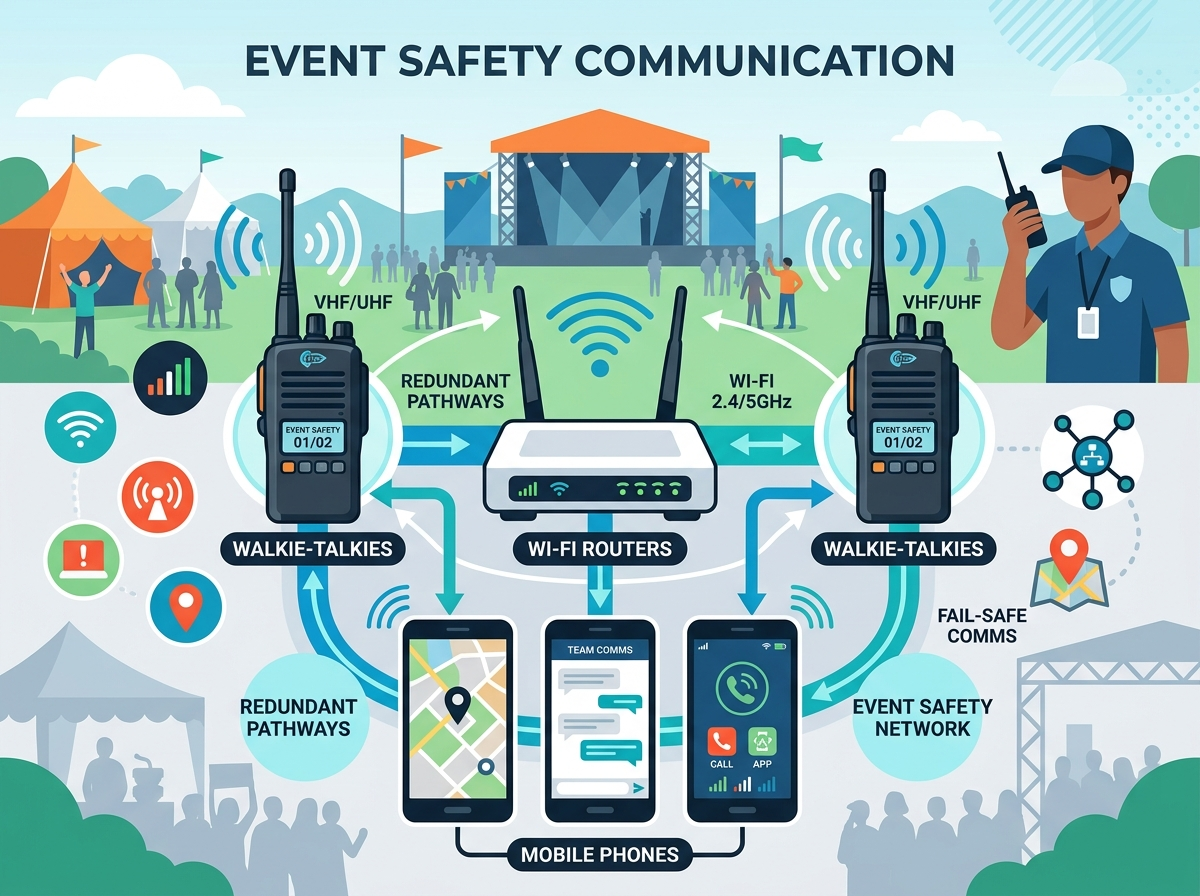
2. Redundant, Multi-Channel Communication Systems
The first casualty in any event emergency is almost always the communication network. Local cellular towers quickly become overloaded by thousands of attendees, and standard cellular calls or SMS text messages fail to deliver. To prevent complete communication collapse, your checklist must include redundant communication hardware. This includes multi-channel two-way radios (walkie-talkies) with dedicated earpieces for key staff, a megaphone or loud speaker for crowd control, and a localized physical meeting point for the core team should all electronic channels fail.
It is equally important to test these communication systems in advance. Perform a comprehensive signal check across all areas of the venue, including concrete back-of-house hallways, basements, and outdoor loading docks where signals frequently drop. Establish a dedicated channel layout—such as Channel 1 for security, Channel 2 for medical, and Channel 3 for operations—to prevent overlapping chatter from obstructing critical safety updates.
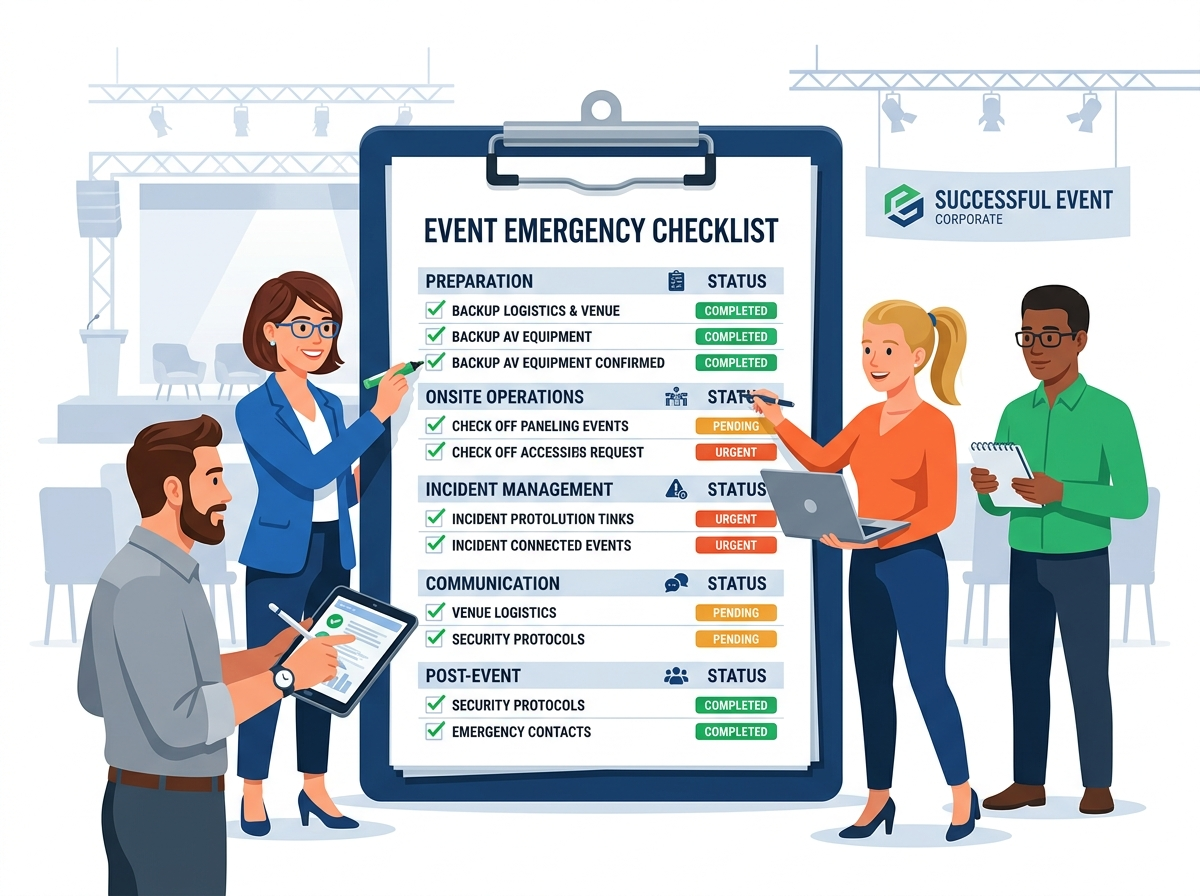
3. Dedicated, Highly Visible Medical Kits and Equipment
A standard workplace first-aid box is entirely insufficient for large-scale events. Your on-site emergency checklist must include multiple fully stocked, industrial-grade trauma and first-aid kits. These kits must be easily accessible, clearly marked with high-visibility signage, and staffed by licensed first responders or medical volunteers. Furthermore, check that Automated External Defibrillators (AEDs) are present on-site, their batteries are fully charged, and their precise coordinates are mapped on your master event layout.
For outdoor or expansive festival grounds, ensure your medical kits include thermal blankets, hydration solutions, and specialized insect or allergy treatments. Every team member must know the exact location of the primary medical station and have instant contact with the on-site medical lead to facilitate rapid treatment and transport when accidents occur.
4. Backup Power and Critical Event Utilities
Electrical failures and sudden blackouts can immediately grind your registration, security, and main stage operations to a complete halt. Your checklist must include verified backup power units, including portable diesel or battery generators, uninterrupted power supplies (UPS) for critical IT infrastructure, and multiple heavy-duty extension cords. Ensure that all critical lanes, exit doors, and registration desks have instant, battery-operated emergency lighting so that a sudden power loss does not lead to a crowd crush or immediate panic.
Planners must also work closely with venue engineers to understand the electrical load limits of the building. Distribute power draws evenly across multiple circuits to prevent tripped breakers, and have a dedicated technician on standby during high-volume periods to instantly address power drops or utility failures.
5. Complete Physical and Digital Backup of the Guest List
If your digital check-in system relies entirely on active internet connectivity and the venue’s Wi-Fi fails, your entrance will rapidly devolve into a massive, frustrated bottleneck. To maintain smooth on-site operations, your team must always keep a local, offline-enabled check-in backup. Modern event technology like EventHex Event Registration offers native offline synchronization, allowing your check-in staff to continue scanning tickets, validating barcodes, and printing badges without an active internet connection, automatically syncing the data back to the cloud the moment the network recovers.
Eliminating entrance bottlenecks is not just a matter of customer service; it is a critical safety requirement. Crowded entrance areas with slow-moving lines create high-density zones that increase the risk of crowd surges and accidental trips. By utilizing an offline-resilient digital ticketing and check-in framework, you ensure a continuous, safe, and controlled flow of attendees into the venue regardless of local connectivity issues.
6. Crowd Control, Barriers, and Visible Signage
Managing the physical flow of thousands of people requires clean, intentional structural design rather than manual intervention. Your checklist must include high-visibility hazard tape, safety cones, temporary barricades, and professional “No Entry” or “Danger” signage. Having these materials ready allows you to instantly close off compromised areas, re-route pedestrian traffic around physical hazards, and establish clear, safe boundaries for emergency services on-site.
Clear, physical routing design acts as a natural guide for human behavior. By using temporary barriers and overhead signage, you can visually direct attendees toward emergency exits, separate arriving and departing flows, and prevent dangerous bottlenecks from forming at narrow choke points or stairwells within the venue layout.
7. Personal Protective Equipment (PPE) for the Crew
An exhausted, injured, or unprotected crew cannot effectively protect your attendees. Your on-site show box must contain an ample supply of personal protective equipment (PPE). This includes high-visibility vests for all staff and volunteers, heavy-duty work gloves for physical setup, ear protection for high-decibel environments, dust masks, and weather-specific gear (including rain ponchos and thermal blankets). Equipping your crew with proper PPE ensures they remain safe, visible, and capable of executing their operational duties.
High-visibility apparel is particularly vital during the intense, fast-moving phases of event setup (bump-in) and teardown (bump-out). Ensuring that all production staff, technicians, and local crew are wearing safety-colored vests and protective footwear prevents workplace accidents and allows the operations manager to quickly locate key team members on a busy, crowded floor.
8. Multi-Sized, Heavy-Duty Tape and Fastening Supplies
Minor physical hazards—such as loose cables running across a high-traffic hallway, tearing carpets, or collapsing temporary banners—can quickly turn into major liability issues and physical injuries. Your checklist must include multiple rolls of industrial-grade gaffer tape (which leaves no sticky residue on venue floors), double-sided tape, heavy-duty zip ties, bungee cords, and a robust utility knife or box cutter. Safely taping down cables and securing loose structures is one of the easiest ways to proactively prevent slip-and-trip hazards.
In addition to taping cables, gaffer tape is invaluable for quickly labeling modified doors, securing broken signage, and applying temporary safety markings to unexpected steps or uneven surfaces. A well-stocked toolkit containing versatile fastening materials is the ultimate line of defense against minor physical hazards on-site.
9. Real-Time Security and Local First Responder Directory
When an incident escalates beyond your team’s on-site capabilities, every single second counts. Your checklist must feature an updated, highly accurate directory of local emergency services, including the closest hospital address, local police non-emergency lines, municipal fire departments, and the contact details of the venue’s head of security. This directory should be physically pasted at the EOC and accessible digitally to all team leaders to bypass the delay of standard emergency dispatch lines.
Ensure that this directory also includes specific turn-by-turn directions to the venue’s designated loading zones and emergency vehicle access docks. If emergency services must be called to the site, having a staff member stationed at the main gate with this specific routing information allows them to guide arriving emergency vehicles directly to the incident site without losing precious time navigating public parking zones.
10. A Centralized Operational Dashboard for Real-Time Monitoring
During the chaos of a live event, scattered information is your greatest enemy. You cannot manage an emergency if your registration data is on one platform, your session agenda is on another, and your team’s communication is completely fragmented. This is where a centralized system becomes vital. Incorporating a tool like the EventHex Centralized Dashboard allows event organizers to monitor registration rates, ticket sales, check-in flows, and session schedules from a single, unified command center. Having a centralized dashboard gives you the real-time operational oversight needed to spot bottlenecks, allocate resources, and make informed, high-stakes decisions with absolute clarity.
Centralization also enables seamless post-event debriefing. When all check-in times, registration patterns, and operational changes are captured within a single platform, you can accurately review how your team managed operational stress, identify specific areas where bottlenecking occurred, and continuously refine your checklists and protocols for future launches.
Integrating EventHex as Your Operational Safety Net
An on-site event emergency checklist is an essential operational tool, but its effectiveness is completely multiplied when backed by robust event technology. Traditional event management tools often crumble under the pressure of real-world glitches, leaving planners stranded during critical moments. EventHex is engineered from the ground up to solve these precise operational pain points, providing a modern, reliable infrastructure for elite event organizers.
From the seamless, high-volume capabilities of EventHex Event Registration that prevent on-site entry bottlenecks, to the real-time reporting of the EventHex Centralized Dashboard, EventHex transforms complex, chaotic event logistics into a calm, systematic, and completely controlled operational environment. Explore the full suite of modern event solutions on the EventHex Homepage and learn how you can eliminate the administrative chaos of your next major launch.
Frequently Asked Questions (FAQ)
What should be in an event planner’s basic emergency kit?
A basic event emergency kit (often called a show box or survival kit) should include industrial tape (gaffer and double-sided), heavy-duty zip ties, basic tools (screwdrivers, hammers, box cutters), multi-sized batteries, office stationery, basic cleaning supplies, and essential personal care items (pain relievers, mints, and sewing kits).
How does modern event technology improve on-site safety?
Modern event technology like EventHex improves safety by centralizing attendee data, providing offline-enabled check-in systems to prevent crowd bottlenecks, and offering real-time analytics dashboards. This allows organizers to monitor crowd density, coordinate staff, and make fast, data-driven decisions during live incidents.
How often should an event emergency checklist be updated?
Your on-site event emergency checklist should be reviewed and updated before every single event. This ensures that venue-specific details, local emergency contacts, staff roles, and equipment quantities are fully aligned with the unique scale, location, and parameters of your current event.