
For decades, trade show organizers, expo managers, and B2B event hosts have operated under a silent, exhausting consensus: spreadsheets are the only way to manage exhibitors. You create a master sheet, double-check your columns, and brace yourself for the inevitable deluge of emails, revision requests, and administrative confusion that accompanies every single trade show cycle.
In the beginning, it seems completely harmless. When you are managing fewer than ten exhibitors, a simple Google Sheet or Microsoft Excel workbook is highly flexible, completely free, and incredibly easy to manage. But as your trade show expands, these grids begin to buckle under the weight of real-world logistics. Suddenly, you are not just hosting an event; you are serving as a human database, manually copying and pasting information between tabs, chasing down outstanding payments, and resolving booth assignment conflicts.
This article explores the administrative friction points that define spreadsheet-based exhibitor management, explains why top-tier trade show hosts are systematically upgrading to modern self-service portal systems, and demonstrates how implementing dedicated exhibitor management software can revolutionize your event ROI, enhance sponsor satisfaction, and reclaim hundreds of hours of your planning team’s time.
The Hidden Costs of Spreadsheet Chaos
To understand why trade show hosts are moving away from traditional tools, we must first look at where spreadsheets break down. While they are powerful calculators, they are fundamentally passive systems. They do not send reminders, they do not validate uploaded files, and they cannot verify in real time whether a payment has cleared. The moment you scale beyond 20 exhibitors, several structural limitations become apparent:
1. The Human Database Botleneck
When you rely on spreadsheets, every administrative action requires manual entry. When an exhibitor updates their company description, sends a new logo, or changes their on-site team list, they email you. You must then open your master sheet, find their row, and paste the details in manually. This process turns your organizing team into high-paid data entry clerks, wasting valuable hours that should be spent on strategic marketing, attendee recruitment, or sponsor relations.
2. The Multi-User Version Control Nightmare
Trade show operations are rarely a solo sport. Your sales team is selling booths; your operations lead is managing logistics; your marketing coordinator is building the directory. When multiple team members are working from the same sheet—or worse, separate offline copies—version conflicts are inevitable. One person overrides a booth allocation, another registers a payment, and suddenly you are dealing with double-booked premium booths and missed sponsorship packages.
3. Manual Payment Collection and Reconciliation
Collecting booth fees is the lifeblood of an exhibition, yet spreadsheets cannot process payments. Instead, organizers are forced to collect checks, wire transfers, or direct PayPal invoices, then manually reconcile bank statements with their exhibitor list week after week. The labor-intensive process of chasing balances, sending reminders, and updating receipt logs creates a massive pre-event bookkeeping burden.
Enter the Self-Service Portal: A New Era of Exhibitor Management
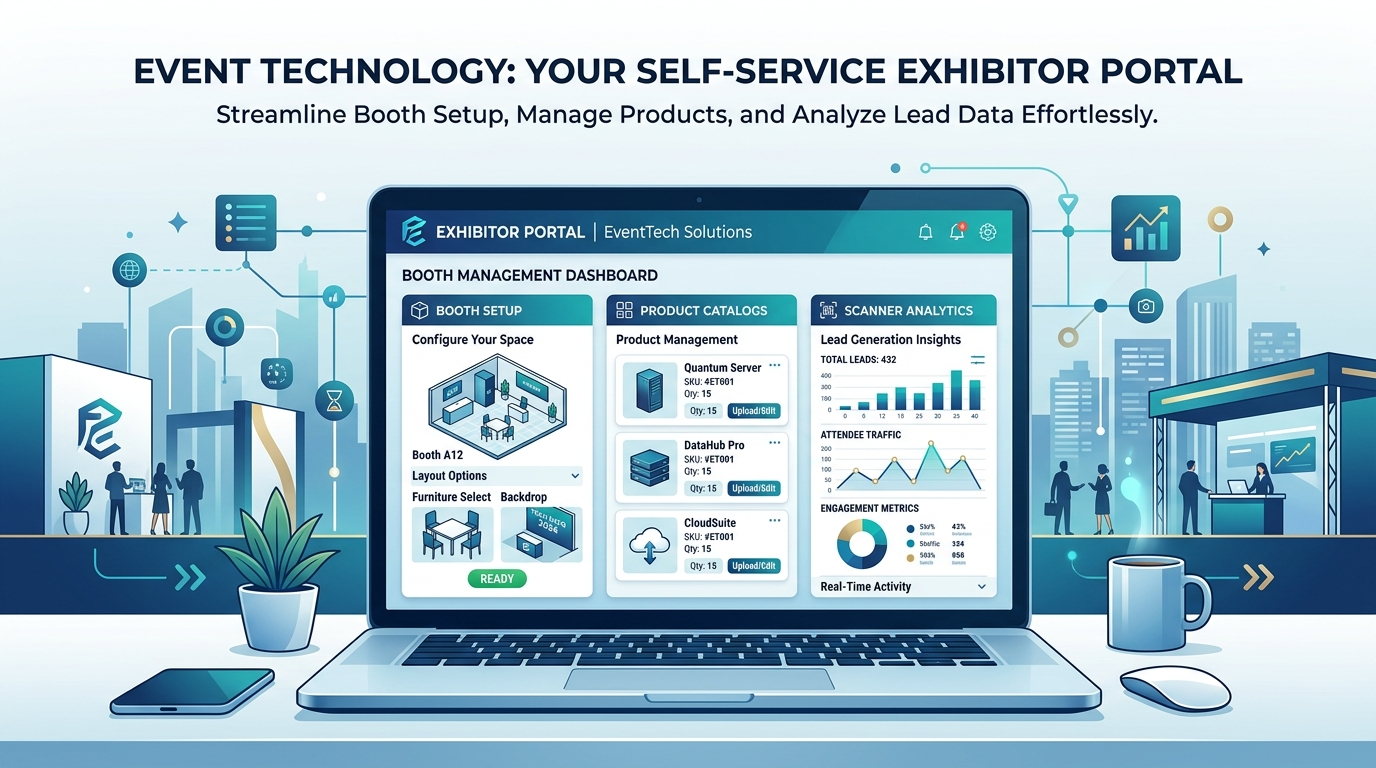
Modern event organizers are resolving these pain points by replacing spreadsheets with dedicated exhibitor management software featuring self-service exhibitor portals. Instead of treating the organizer as a go-between, a portal shifts the administrative ownership directly to the exhibitors. Each exhibitor receives a secure, branded login to their personal workspace, where they manage their own profile, setup, and deliverables.
By transforming your workflow from push-based administration (organizers chasing vendors) to pull-based self-service (vendors updating their own records), you instantly eliminate up to 80% of organizer email volume. Exhibitors enjoy having total control over their brand presentation, and your team is freed from the endless copy-paste cycle.
Guided Booth Setup and Document Submissions
Inside their self-service portal, exhibitors are guided through an interactive setup wizard. The system prompts them to upload their logos, enter descriptions, submit required insurance or compliance documents, and list social media links. If a file is missing or formatted incorrectly, the portal flags it automatically, ensuring that all directories and promotional materials are completely accurate before the show floor opens.
Exhibitor Product Catalogs and Pass Management
Exhibitors are not just booking physical space; they are showcasing their business. Advanced exhibitor portals allow them to upload and manage their own digital product catalogs—complete with descriptions, photos, and pricing. Attendees can browse these catalogs on your public-facing event website or mobile app before they set foot in the venue. Additionally, exhibitors can manage their staff allocations, inputting team details to automatically generate on-site exhibitor passes without organizing team intervention.
Elevating On-Site Performance: Lead Retrieval & Interactive Maps
The administrative benefits of upgrading to exhibitor management software are immense during the planning phase, but the true magic happens on-site. Traditional trade shows often struggle to prove ROI to their sponsors. Exhibitors spend thousands of dollars to set up elaborate booths, yet they walk away with a stack of business cards that must be typed manually into a CRM, or worse, lost in transit.
QR Lead Scanning: Instant ROI for Exhibitors
With modern exhibitor software, every booth staff member’s smartphone is transformed into a high-powered lead retrieval scanner. Using your event’s dedicated portal or mobile app, booth staff scan attendee QR codes instantly. Contact details, company roles, and demographic data collected during registration are captured in real time. Exhibitors can rate leads (hot, warm, cold), attach custom qualification notes, and synchronize records directly with CRM platforms like HubSpot or Salesforce.

This streamlined digital flow eliminates manual lead transcription and empowers exhibitors to demonstrate concrete event ROI. Instead of waiting days after the event to receive attendee databases, exhibitors walk out of the hall with a polished, actionable digital list ready for follow-up.
Interactive Floor Plans and Visual Booth Allocation
Managing the physical floor plan is another common operational headache. When an exhibitor requests a change, dragging lines in Illustrator or Excel and republishing a static PDF map is incredibly tedious. Exhibitor management systems solve this with dynamic, interactive floor plans. Organizers can map out the venue, define booth dimensions, set pricing tiers, and assign placements using a visual drag-and-drop interface.
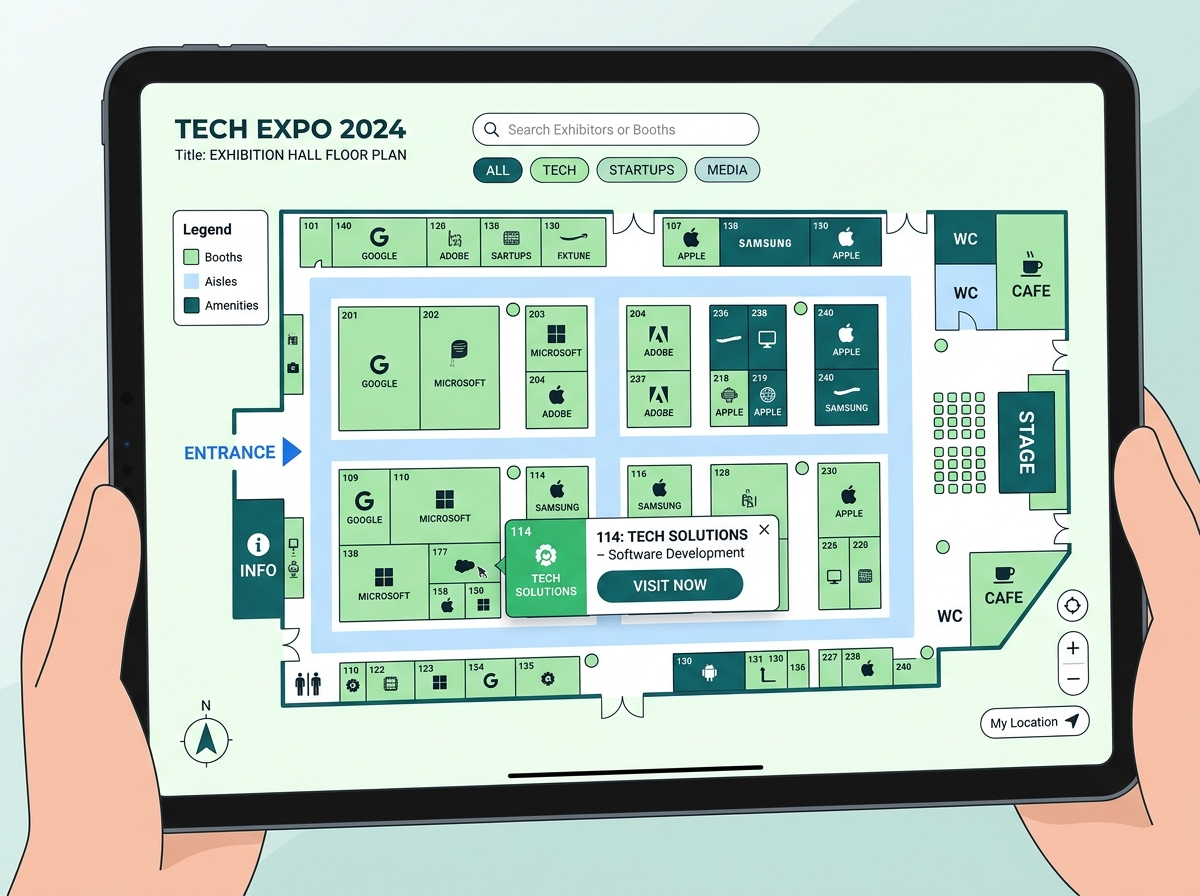
These floor plans integrate directly with your public website, allowing registered attendees and prospective exhibitors to search booth availability, filter by industry category, and map out their path through the exhibition hall. Any floor plan update made by the organizer is immediately pushed live across all attendee platforms, ensuring perfect alignment between the digital layout and the physical hall.
Transitioning Your Event: The Strategic Upgrade to EventHex
If you are ready to ditch the spreadsheet chaos and transition your trade show to a self-service model, EventHex provides the ideal enterprise-grade platform. Designed specifically to automate and simplify B2B trade shows, EventHex replaces fractured tools with an elegant, unified exhibitor ecosystem.
With EventHex, organizers can create tiered exhibitor packages, assign visual booths via interactive floor plans, and invite sponsors to their own private, secure self-service portal. On the event day, EventHex’s mobile-first QR lead capture enables staff to capture leads instantly, while organizers monitor live check-in performance from a single centralized dashboard. Best of all, EventHex integrates smoothly with your public event registration pages, aligning attendee check-ins, ticketing tiers, and exhibitor lead databases under one powerful system.
Conclusion
The transition from manual spreadsheet tracking to modern exhibitor management software is not just an upgrade in technology; it is a fundamental shift in operational philosophy. By empowering your exhibitors with self-service tools, automating payment collection, providing digital floor plans, and enabling instant on-site lead retrieval, you build a trade show that is highly efficient, scale-ready, and intensely valuable to sponsors.
Stop chasing emails and correcting broken formulas. Give your team the operational breathing room they deserve, and offer your exhibitors a premium experience they will want to return to year after year.
Frequently Asked Questions (FAQ)
What is an exhibitor portal?
An exhibitor portal is a secure, branded, self-service web space where trade show vendors can manage their booth profiles, upload logos, list product catalogs, manage on-site staff passes, and retrieve leads—all without needing to email the event organizer for manual database updates.
How does exhibitor management software improve event ROI?
It provides exhibitors with real-time digital lead retrieval tools (such as QR scanning on mobile devices) to capture and qualify attendee contacts instantly. It also enables self-service product catalog directories, boosting pre-event and on-site brand visibility to drive more qualified sales interactions.
At what point should an organizer transition away from spreadsheets?
While spreadsheets work for small markets under 15 vendors, organizations running B2B expos with more than 20 exhibitors, multiple booth sizes, premium add-ons, or team-wide collaboration should upgrade to dedicated software to avoid version conflicts, manual payment reconciliation, and administrative bottlenecks.
Can EventHex integrate with other registration systems?
EventHex works best as a unified solution, integrating attendee registration directly with exhibitor lead retrieval. This allows exhibitors to immediately scan attendee badges and view enriched registration profiles on-site, syncing leads smoothly with their internal sales CRMs.