Picture this: Your high-budget corporate summit, charity gala, or music festival has just concluded. Your professional photography team delivered thousands of stunning, high-resolution images capturing the keynote presentations, networking handshakes, and candid smiles. To share them with your attendees, you do what organizers have done for the last decade—you bulk-upload the entire batch into a public Google Drive folder, Dropbox link, or OneDrive directory, and blast the URL out to your email list.
Within minutes, the friction begins. Attendees open the link on their mobile devices only to be greeted by an endless grid of microscopic thumbnails. To find the two or three pictures they are actually in, they must scroll through thousands of photos of strangers, catering trays, and empty stages. Frustrated by the digital scavenger hunt, most give up and close the browser tab. The massive investment you made in professional photography evaporates into a digital black hole, leaving you with near-zero post-event engagement, zero marketing data, and zero brand exposure.
This is the classic "findability" problem of legacy cloud storage. Today, forward-thinking event organizers are abandoning public photo folders entirely. Instead, they are turning to the power of an AI event photo gallery to transform passive, cluttered storage folders into a frictionless, instant, and highly monetizable distribution channel. By replacing manual scrolling with real-time AI face matching, platforms like EventHex are redefining how memories are delivered and shared in the modern event landscape.
The Multi-Faceted Pain Points of Public Cloud Folders
While services like Google Drive, Dropbox, and Microsoft OneDrive are brilliant for internal document storage and personal backups, they were never designed to handle live public distribution. When used as an impromptu event gallery, cloud drives present critical bottlenecks that disrupt the attendee journey and dilute event marketing efforts.
1. The "Doom Scroll" and the Where’s Waldo Experience
When you share a link containing 2,000 unorganized photos, you force your guests to play a frustrating game of "Where’s Waldo?" A standard mobile browser struggling to render high-resolution thumbnails over cellular data is an immediate recipe for high drop-off rates. Because attendees have to sort through endless files manually, the average visitor spends less than two minutes browsing before abandoning the search. The value of your photography investment remains locked away simply because finding it is too much work.
2. The Sign-In Barrier and App Friction
Cloud drives heavily favor users who belong to their respective ecosystems. If an attendee scans a QR code to view a shared Google Drive folder on their phone, they are frequently prompted to sign in with a Google Account. This minor friction creates an immediate roadblock for non-technical users, corporate attendees logged into restricted workspace profiles, or anyone who simply forgot their credentials. The requirement of an account login or app download is a proven killer of immediate engagement.
3. The Nightmare of Zero Quality Control
If you set your shared folder to collaborative mode to let attendees contribute their own photos, you invite immediate chaos. Your highly polished, professionally shot gallery quickly becomes cluttered with blurry, dark, duplicate mobile snapshots, out-of-focus group photos, and low-quality content. You lose complete editorial control over how your event is visually represented online.
Privacy and Compliance: The Hidden Legal Minefield of Shared Folders
Beyond poor user experience, public folders pose severe security risks. When you publish a "View All" link to thousands of event images, you are publicly exposing the faces, companions, and actions of every single attendee to everyone else on the internet. In an era governed by strict data privacy frameworks, this is an operational liability waiting to happen.
GDPR, CCPA, and Corporate Boundaries
For corporate and enterprise summits, professional boundaries are paramount. Forcing attendees to browse through a public gallery where they can view photos of competing firms networking, or worse, casual photos from an after-party, is highly unprofessional. Under regulations like GDPR and CCPA, sharing recognizable biometric features (such as faces in photographs) in a completely unrestricted public format without a robust mechanism for consent or immediate removal exposes organizations to severe regulatory compliance penalties.
The Risk of Image Scraping
Unprotected public folders are goldmines for automated web scrapers. Anyone with the link can easily bulk-download your entire photo assets, exposing your attendees’ likenesses to unauthorized AI model training datasets, spam lists, or worse, targeted social engineering. Protecting your attendees’ digital footprints is no longer an optional courtesy—it is a core organizational responsibility.
Enter the AI Event Photo Gallery: Instant, Secure, and Automated Delivery
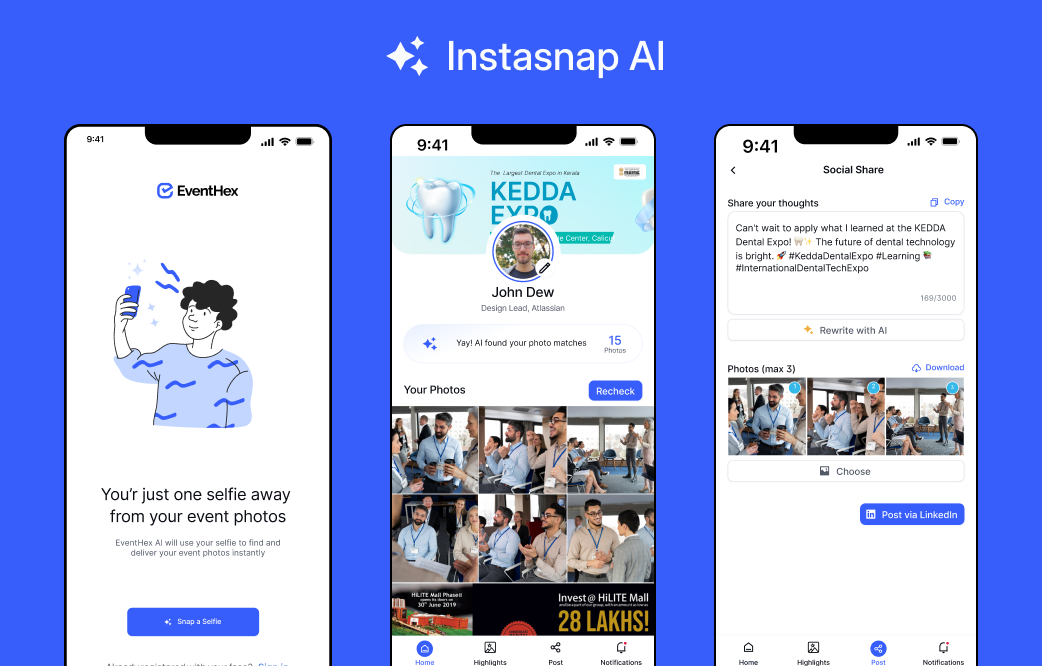
An AI event photo gallery like EventHex's InstaSnap AI Photo Gallery completely upends the traditional distribution workflow. Instead of asking attendees to search for their images, the platform searches for them. The technology transforms a clunky post-event chore into a seamless, high-engagement highlight of the attendee journey.
How Selfie-to-Photo Matching Works
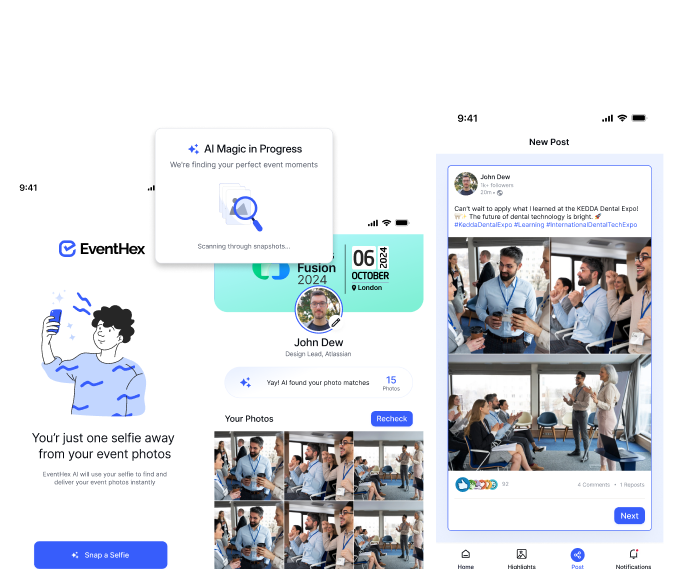
The process of utilizing an AI event photo gallery is entirely frictionless and takes only three simple steps for the guest:
- Scan a QR Code: Attendees scan a customized QR code at the venue or click a link in their follow-up email. There is absolutely no app installation or account sign-up required.
- Snap a Selfie: The attendee takes a quick, private selfie directly within their mobile browser window.
- Instant Match: In under 3 seconds, the enterprise-grade AI engine scans the entire event database, analyzes facial landmarks, and retrieves every single high-resolution image featuring that attendee.
Whether they appear in sharp solo headshots, crowded breakout sessions, or candid networking circles, the AI clusters and delivers their matched photos with over 95% accuracy. If the AI cannot confidently match a face due to poor lighting, attendees can still easily browse curated folders manually, ensuring no one is left behind.
A Privacy-First Architecture
Unlike public folders, a modern AI event photo gallery puts privacy at the forefront. Built-in compliance controls enable organizers to lock down visibility so that attendees can only see the photos where their face is matched, completely preventing them from browsing other guests’ photos. Furthermore, all uploaded facial data is securely encrypted, used strictly for matching purposes, and automatically deleted based on custom retention policies, keeping your event fully aligned with GDPR and corporate security requirements.
Unlocking New Sponsorship Revenue and Viral Brand Awareness
Beyond solving the logistical nightmare of photo distribution, an AI event photo gallery turns your event media into a powerful digital marketing asset. Every time an attendee downloads and shares an event photo, they become an active ambassador for your brand—provided you have the tools to capture that value.
1. Seamless Sponsor Integration and Branded Overlays
Public Google Drive links offer absolutely no branding opportunities. With EventHex, your gallery is an extension of your brand ecosystem. Organizers can automatically apply beautiful, custom-designed co-branded frames, logos, and sponsor watermarks to every matched photo. When attendees immediately download their stunning photos and post them on platforms like LinkedIn, Instagram, or X, your brand and your sponsors' logos are displayed front and center to their entire professional network, maximizing organic impressions.
2. Driving Real Post-Event Engagement
Because the selfie matching experience is fast, fun, and highly personalized, it boasts engagement rates that public folders cannot dream of matching. Instead of a passive 10% view rate on Google Drive, an AI-powered gallery typically sees over 85% of attendees scanning, matching, and downloading their photos. This high interaction rate opens up highly valuable real estate for targeted in-gallery banner ads, call-to-action buttons linking to your upcoming events, or promotional codes from your premium sponsors.
3. Integrating into the Entire EventHex Ecosystem
The true power of an AI event photo gallery is realized when it works in perfect harmony with your entire event management stack. As part of the unified EventHex suite, your photo distribution connects natively with your ticket sales and check-in workflows. Organizers can seamlessly guide attendees from initial online Event Registration, through real-time venue check-ins via the Centralized Dashboard, all the way to instant, face-matched photo delivery at the end of the day. This cohesive approach eliminates fragmented tools and provides a single, polished attendee experience from start to finish.
The Strategic Verdict: Why Google Drive is Yesterday’s Solution
When planning your next event, the technology you choose to distribute your media speaks volumes about your commitment to attendee experience. Continuing to use Google Drive is an outdated approach that sacrifices engagement, risks privacy compliance, and leaves massive branding opportunities on the table.
An AI event photo gallery like EventHex InstaSnap solves every operational bottleneck of photo delivery. It eliminates the manual "doom scroll" for guests, maintains rigid security standards, and turns every downloaded photo into a high-ROI asset for your brand and sponsors. It is time to ditch public folders and embrace the future of smart, automated event photo sharing.
Ready to upgrade your next event with frictionless, secure, and sponsor-ready AI photo delivery? Discover how easy it is to set up by visiting the EventHex Homepage or booking a personalized demo of the AI Photo Gallery today.
Frequently Asked Questions
How does AI face recognition in an event photo gallery work?
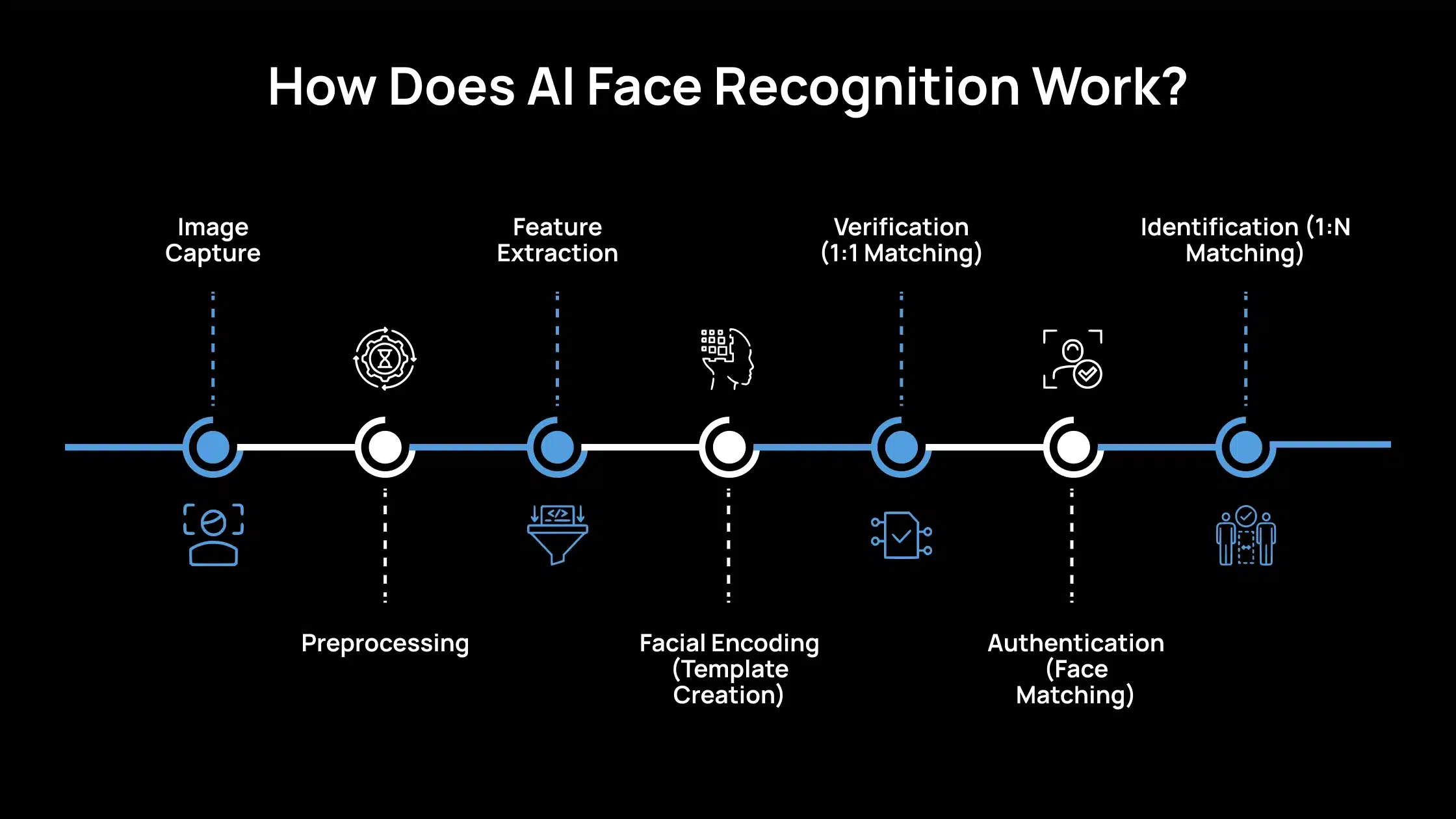
The AI photo gallery uses advanced face recognition models (such as AWS Rekognition) to scan and cluster faces immediately as photos are uploaded. When an attendee visits the gallery web link, they take a quick selfie. The engine instantly compares the facial landmarks of the selfie against the database to retrieve all matched images in less than three seconds.
Do attendees need to download an app to find their photos?
No, there is absolutely no app installation or account sign-up required. Attendees simply scan a QR code at the venue or click a link to open the secure web gallery directly on their mobile browser, upload their selfie, and access their matched photos instantly.
Is an AI face matching gallery GDPR and CCPA compliant?
Yes, security is a core component. Modern platforms like EventHex use privacy-first designs. All selfies uploaded for matching are encrypted, utilized strictly for the matching process, and automatically purged based on strict retention rules. Organizers can also enable rigid opt-out controls and restrict photo visibility so guests can only view their own matched images.
Can we add custom watermarks or sponsor frames to the downloaded photos?
Yes, the dashboard allows organizers to configure automated watermarking rules, sponsor banners, and co-branded graphic frames. Every photo downloaded by an attendee automatically carries your event branding and sponsor logos, creating an organic social sharing loop across networks like LinkedIn and Instagram.
How many photos can the EventHex AI Photo Gallery process?
The system is engineered to handle massive event volumes. Photographers can drop thousands of high-resolution images simultaneously through bulk upload tools, and the background AI engine will automatically index and match files in real-time while the event is still ongoing.