In the high-stakes world of B2B events, the true measure of success isn’t just how many tickets are sold or how grand the venue is. Rather, it is the quality of the connections made. Attendees do not fly across the country or block out days of their busy calendars merely to consume content they could easily watch on YouTube; they attend to meet clients, establish strategic partnerships, and close deals. Yet, despite networking being the primary driver of event attendance, traditional event matchmaking remains a frustrating bottleneck for event hosts and attendees alike.
See the switch in practice: EventHex’s AI event matchmaking software replaces spreadsheet matchmaking with automatic goal-based pairing.
For decades, event hosts have relied on manual matchmaking. This typically involves hundreds of hours of spreadsheet coordination, tedious email back-and-forths, and a heavy dose of guesswork. Today, that approach is no longer sustainable. As attendee expectations skyrocket and event scales expand, forward-thinking event organizers are abandoning spreadsheet chaos. Instead, they are switching to modern, automated ai event matchmaking to deliver seamless, high-value B2B networking at scale.
The Hidden Friction of Manual Event Matchmaking
Traditional manual matchmaking is built on good intentions but terrible execution. To appreciate why hosts are moving away from manual methods, we have to look closely at the operational friction and the attendee pain points that this old-school model creates.
1. The Spreadsheet Trap and Data Congestion
Imagine managing a B2B matching event for 500 attendees. Each participant fills out a long registration form listing their interests, industry, company size, and what they are looking for. The event coordinator must then manually pore over 500 rows of complex, qualitative data, trying to play matchmaker. The logistical burden is staggering. Because human brains are simply not built to cross-reference thousands of data points simultaneously, matches are often superficial, based solely on basic industry categories rather than precise mutual alignment. When registration details are modified at the last minute, the entire manual grid crumbles, leading to scheduled conflicts and double-booked tables.
2. The Asymmetry of Manual Information Exchange
In a manual setup, attendees have very little control over their networking destiny. They receive a static PDF or sheet listing other attendees, and are forced to guess who might be a good fit. Alternatively, hosts try to assign meetings manually behind closed doors. This often results in “dead-end” meetings—conversations where one party has zero interest in what the other is offering. In B2B environments, time is literally money. Forcing senior executives or busy founders into mismatched 1-on-1 meetings is a fast track to low satisfaction scores and declining attendee retention rates.
3. High Operational Stress and Staff Burnout
Setting up meetings manually is an administrative nightmare. Staff members spend weeks manually coordinating meeting calendars, sending calendar invites, and answering hundreds of frantic emails about meeting locations, schedule updates, or cancellations. During the actual event, staff are constantly running around resolving scheduling conflicts, manually directing lost attendees to specific meeting tables, and putting out fires. This operational overhead takes the focus away from actual event execution and hospitality.
What is AI Event Matchmaking and How Does It Work?
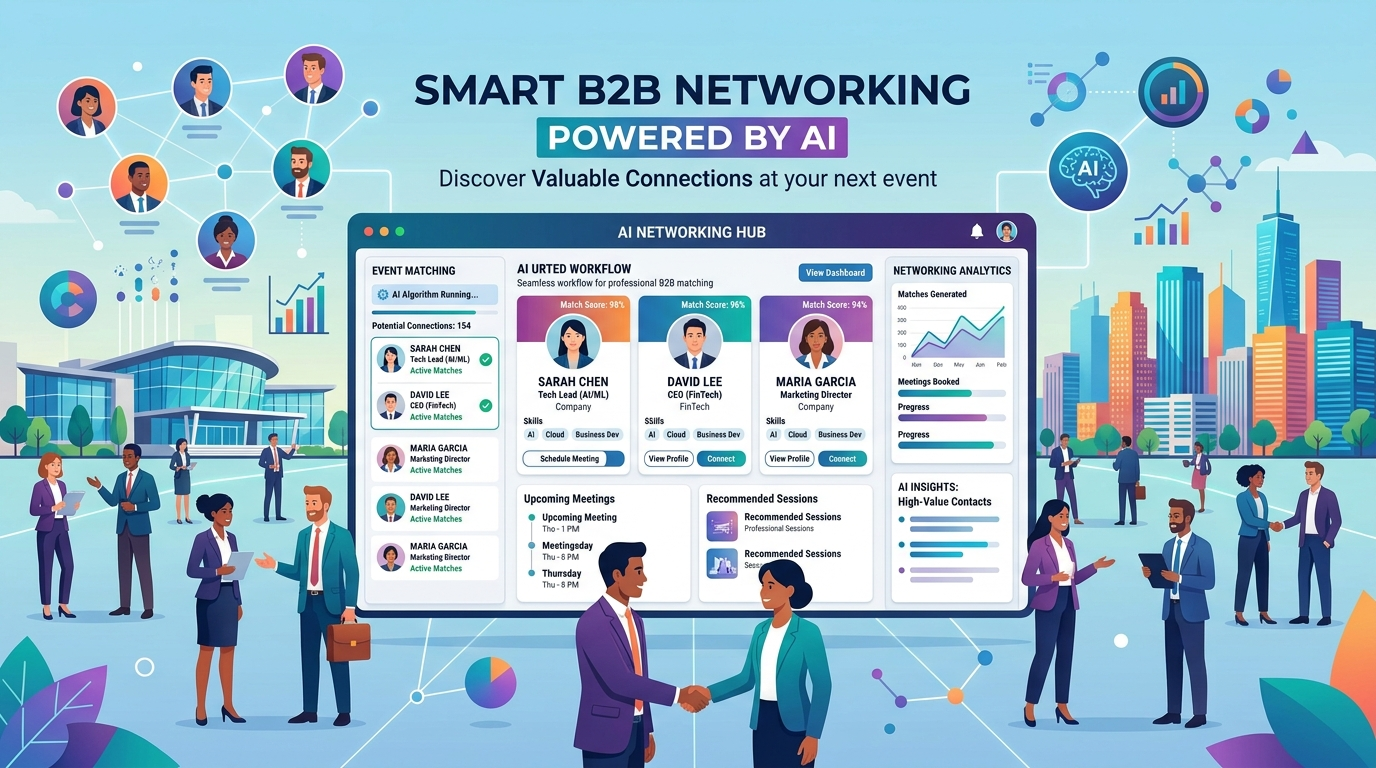
To put it simply, ai event matchmaking is the process of using machine learning algorithms and advanced data analysis to automate and optimize professional networking. Rather than relying on rigid filters or manual human processing, an AI-powered system processes massive amounts of attendee data to predict and recommend the most valuable connections for each specific attendee.
When attendees register through a streamlined event registration system, they provide key data points. The AI algorithm does not just look at static labels like job titles. It analyzes multi-dimensional data, including business objectives, current challenges, target audience demographics, historical networking behavior, and live platform interactions (such as profiles viewed or bookmarked). By looking at the complete picture, the AI meeting recommender can identify subtle synergies that humans would never notice on a spreadsheet, immediately suggesting high-relevance professional matches.

Why Hosts Are Fast-Switching to AI Event Matchmaking
The transition from manual matchmaking to AI networking is not a temporary trend; it is a fundamental shift in how successful B2B events are run. Here is a breakdown of why hosts are eagerly making the switch:
1. Hyper-Personalized Attendee Journeys
Every attendee arrives at an event with unique goals. A startup founder might be looking for early-stage venture capital, while a corporate buyer is searching for enterprise software solutions. AI event matchmaking algorithms treat every attendee as an individual, curating a custom recommendation feed tailored directly to their precise business goals. This personalization dramatically increases meeting acceptance rates and guarantees that every scheduled meeting has a high probability of driving real business outcomes.
2. Massive Time Savings and Seamless Automation
With an AI matchmaking platform, the manual labor of matching, scheduling, and logistics is completely automated. Attendees can easily browse their personalized recommendations, send meeting invites, and accept or decline requests in real time. Once a meeting is mutually agreed upon, the platform automatically schedules the session, assigns a dedicated meeting table or virtual link, and synchronizes the details directly to the attendees’ personal calendars. Host intervention is virtually zero, allowing planners to refocus their energy on high-value strategy.
3. Robust Data Insights and Measurable ROI
Manual matchmaking provides absolutely no visibility into meeting quality or attendee satisfaction. AI networking platforms, on the other hand, capture rich behavioral data. Hosts can monitor how many meeting invitations were sent, how many were accepted, which topics generated the most interest, and even collect post-meeting feedback and ratings. This continuous loop of data allows event organizers to prove clear ROI to sponsors and stakeholders, while gathering the precise insights needed to refine and optimize networking experiences at future events.
EventHex: The Elegant, End-to-End Modern Solution
While having a smart networking algorithm is crucial, true event success requires a unified platform where registration, credentialing, and matchmaking all work together seamlessly. This is where EventHex shines as the ultimate all-in-one event management ecosystem.
If you are switching to AI-powered networking, you cannot afford to have a fragmented attendee journey where users have to jump between a registration tool, a networking app, and a physical check-in desk. EventHex unifies all of these phases into one cohesive, sleek experience managed via a powerful centralized dashboard. The journey begins with frictionless, custom-branded event registration, where key attendee data points are gathered and instantly fed into the AI matchmaking engine. From there, attendees can immediately begin discovering high-relevance matches and scheduling high-value meetings weeks before the event doors even open.
But the EventHex magic doesn’t stop in the digital realm. The modern B2B attendee expects their digital connections to transition smoothly into the physical venue. EventHex bridges this gap with its industry-leading, visual Badge & Certificate Designer.
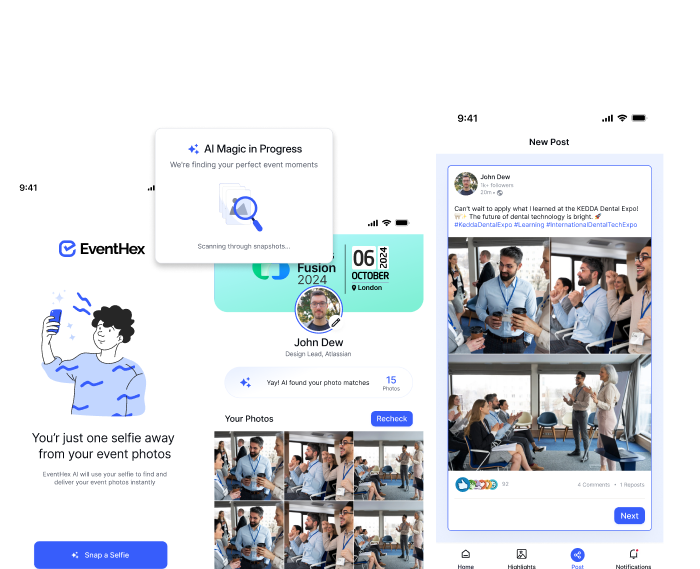
Using the visual designer, hosts can easily create beautiful, custom-branded event badges equipped with smart QR codes. When attendees arrive at the venue, they scan their QR code at a self-service check-in kiosk and receive their professionally printed physical badge in under 5 seconds. This frictionless check-in sets an elite first impression. Once inside, these same QR codes on their badges become their physical networking key. Attendees can scan each other’s badge QR codes to instantly exchange digital contact details, log the connection in their attendee portal, and schedule follow-up B2B meetings on the fly. EventHex turns complex, fragmented operations into a unified, high-performing networking machine.
Step-by-Step: Transitioning from Spreadsheet Chaos to AI Networking
Ready to make the switch for your next event? Follow this practical, industry-standard roadmap to implement AI event matchmaking seamlessly:
Step 1: Unify Your Registration and Matchmaking
Do not use separate tools for registration and networking. Choose an integrated system like EventHex where registration fields feed directly into the AI recommender. Ensure your registration questionnaire asks clear, goal-oriented questions, such as “What is your primary goal at this event?” and “Which industries are you looking to connect with?”
Step 2: Launch the Matchmaking Portal Early
Do not wait until the day of the event to open matchmaking. Open the digital portal 2 to 3 weeks prior to the event. This pre-event window gives attendees ample time to review their AI recommendations, initiate chats, and pre-schedule high-value 1-on-1 meetings, generating intense pre-event buzz.
Step 3: Prepare the Venue for Matchmaking
Designate a clear, dedicated B2B Networking Zone or Matchmaking Lounge at your venue. Number your tables clearly. When the AI platform automatically schedules a meeting and assigns a table (e.g., “Table 14”), attendees should be able to walk in and find their designated meeting point in seconds without any friction.
Step 4: Streamline the On-Site Flow
Pair your high-tech matchmaking with frictionless physical credentials. Use the EventHex Badge & Certificate Designer to print custom badge designs on arrival. A fast, self-service check-in kiosk ensures attendees bypass long lines and head straight into their pre-scheduled B2B meetings energized and focused.
Conclusion: The Era of Manual Matchmaking is Over
In the highly competitive event industry, attendee satisfaction is the ultimate metric. Continuing to rely on clumsy, manual spreadsheets for B2B matchmaking is an operational liability that frustrates attendees, burns out event staff, and fails to prove event ROI. Switching to ai event matchmaking is no longer just an innovative perk; it is a necessity for hosts who want to remain competitive.
By automating the scheduling logistics, personalizing connection paths, and merging physical convenience with digital intelligence through tools like EventHex, hosts can drive massive attendee satisfaction, elevate sponsor value, and build thriving, high-retention event communities. The future of B2B event networking is intelligent, automated, and seamless. It is time to leave the spreadsheet chaos behind and embrace the power of AI.
Frequently Asked Questions (FAQ)
What is the difference between standard filtering and AI event matchmaking?
Standard filtering simply groups attendees based on broad, rigid categories (such as matching everyone in “Marketing” with everyone in “Sales”). This often results in a massive number of irrelevant search results that attendees must manually sift through. In contrast, ai event matchmaking uses machine learning algorithms to analyze multi-dimensional attendee profiles, search behaviors, and explicit goals to dynamically suggest and rank only the most relevant, highly tailored professional connections.
Is AI event matchmaking complicated for attendees to use?
Not at all. In fact, it is significantly easier than traditional manual search. Attendees simply log into their user portal, where they are immediately presented with a curated list of their “Top Matches” and a simple button to invite them to a meeting. The AI-powered system handles all scheduling, timezone adjustments, and table assignments behind the scenes, making the entire networking experience effortless.
How does EventHex streamline B2B networking on-site?
EventHex unifies digital matchmaking with physical event operations. Through its Badge & Certificate Designer, the platform allows hosts to generate custom, QR-code-enabled badges. Attendees can scan these QR codes at on-site kiosks to print their badges in under 5 seconds, and use those same badges to easily scan and exchange digital contact details with other matched attendees they meet at the venue.
Can AI matchmaking support virtual, hybrid, and in-person events?
Yes. A robust platform like EventHex is fully flexible. For virtual events, the system auto-generates secure video conferencing rooms for matched meetings. For hybrid and in-person events, the platform automatically reserves physical meeting tables or booth locations at the venue and dynamically integrates them into the attendee’s personal event schedule.