
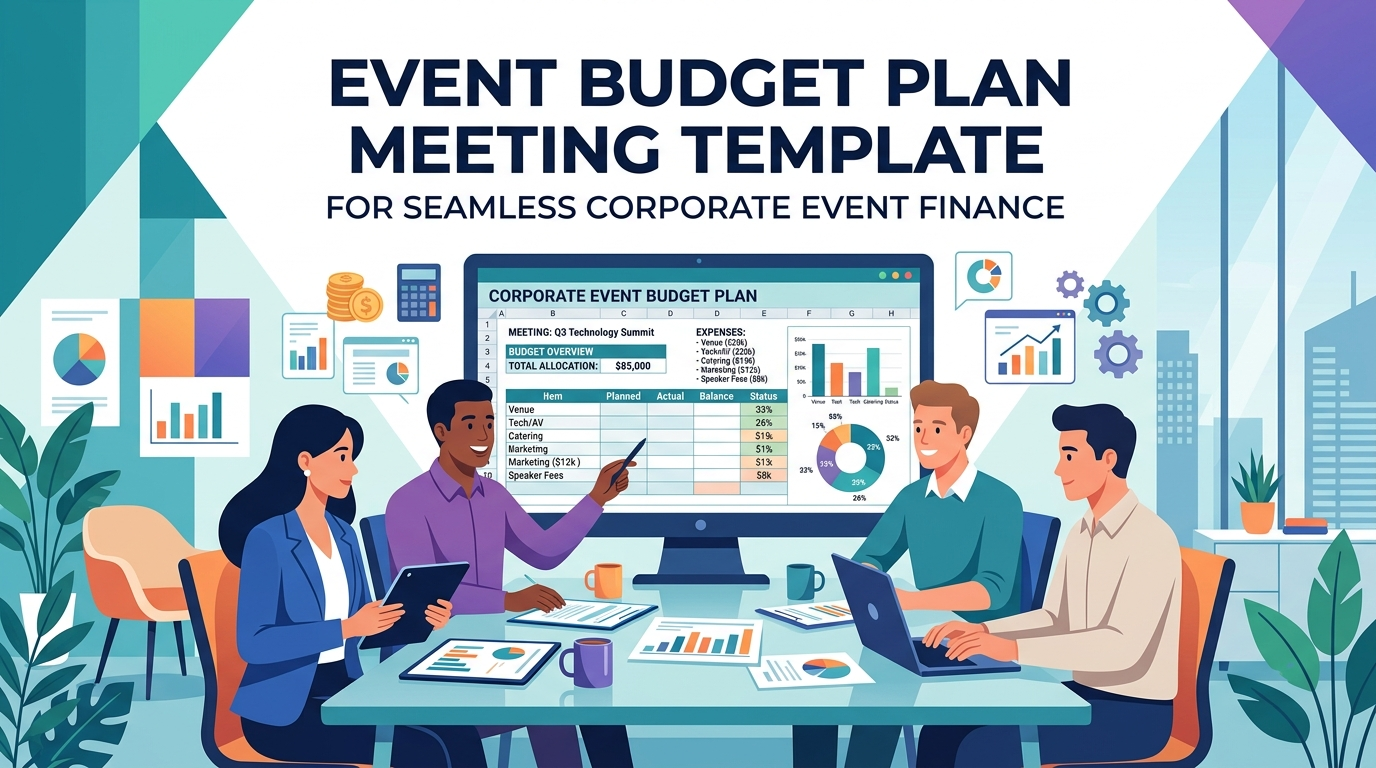
For corporate event planners, trade show organizers, and marketing executives, the annual budgeting process is often the most stressful phase of any event cycle. Under the best circumstances, coordinating a high-profile corporate meeting, product launch, or industry conference requires managing dozens of moving parts. Under average circumstances, it involves battling a silent, exhausting enemy: budget variance and administrative friction.
Studies show that without a structured, standardized financial framework, corporate events experience an average budget overrun of 10% to 15%. These variances are rarely the result of a single catastrophic expense; instead, they are driven by a slow accumulation of hidden venue charges, last-minute AV additions, operational oversight, and manual data-entry errors. When planning teams spend hours manually copying and pasting financial data between separate tools, they are not just wasting time—they are leaving their organization vulnerable to costly budget overruns and missed return on investment (ROI) opportunities.
To eliminate this financial guesswork and empower organizers to execute flawless, cost-controlled corporate events, we have compiled this comprehensive, highly authoritative event planning guide and strategic event budget template. Below, we break down the operational blueprint for corporate event budgeting, analyze key cost categories, demonstrate how to calculate tangible event ROI, and show how modern tools like EventHex streamline registrations and financial tracking under one unified system.
The Financial Tightrope: Why Corporate Event Budgets Miss the Mark
Corporate events are fundamentally high-stakes business investments. Whether you are hosting a 100-person leadership summit or a 5,000-person high-volume conference, every dollar spent must be strategically justified. Yet, many planning teams continue to track hundreds of thousands of dollars in spend using outdated, disconnected sheets or passive calculators. This approach creates several critical failure points:
- The Copy-Paste Bottleneck: When vendor invoices, attendee ticket sales, sponsorship packages, and badge printing costs are tracked in different offline files, organizers must manually merge the data. This human database bottleneck wastes valuable planning hours and inevitably introduces transcription errors.
- Lack of Real-Time Visibility: If your budget is not dynamically connected to your registration flow, you cannot accurately reconcile estimated vs. actual revenue. By the time you notice ticket sales are falling short of your catering minimums, it is often too late to renegotiate contract terms.
- Hidden Operational Costs: From venue service charges and taxes (which can add up to 30% to catering bills) to Wi-Fi surcharges and overtime labor, unstandardized templates frequently fail to account for the auxiliary fees that define on-site logistics.
By establishing a standardized event budget template that categorizes every operational asset and automates reconciliation, corporate event hosts can transform financial tracking from a passive pre-event chore into a proactive, strategic tool.
Breaking Down the Blueprint: Key Event Budget Categories
To ensure your event budget remains balanced and easily auditable, it is essential to segment your expenses into logical, standardized categories. A professional corporate event budget should be structured around four major operational pillars:
1. Venue & Catering (The Lion’s Share)
Typically accounting for 40% to 50% of your total event expenditure, this category encompasses physical room rentals, audiovisual (AV) production, food and beverage minimums, service fees, and gratuities. When negotiating venue contracts, always require itemized lines for every day of the setup, show, and teardown cycles. Be sure to account for minimum guarantee thresholds for catering to avoid paying for vacant attendee seats.
2. Event Technology & Production
Modern corporate meetings run on technology. This category includes your event registration platform, virtual streaming software, mobile attendee apps, check-in software, and on-site visual production. Investing in an integrated technology suite minimizes the need for multi-platform integrations, drastically reducing software licensing fees and data-handling costs.
3. Operations, Logistics & Badge Printing
The physical logistics of welcoming attendees on-site are a frequent source of budget leakages. This pillar covers physical badge printing, lanyards, on-site signage, registration staff, security, and local transport. To prevent massive paper waste and avoid administrative chaos, planners must utilize badge printing systems that feature offline-first synchronization and automatic duplicate prevention, keeping physical supply costs tightly controlled.
4. The 10% Contingency Golden Rule
No matter how meticulously you plan, unexpected expenses will arise on-site. A last-minute speaker request, emergency signage, or extra power drops can quickly throw your finances into disarray. A non-negotiable rule of corporate event management is to allocate a hard 10% contingency fund directly into your master budget. This reserve should remain untouched throughout the planning phase, reserved strictly for real-world emergencies on the event day.
Step-by-Step: How to Use Our Strategic Event Budget Template
To help you manage these complex financial streams, we have developed a dynamic, professional corporate meeting budget template. It is designed around a three-step reconciliation flow to ensure absolute accuracy from your initial pitch to the final post-show wrap-up:
Phase 1: Estimated vs. Actual Reconciliation
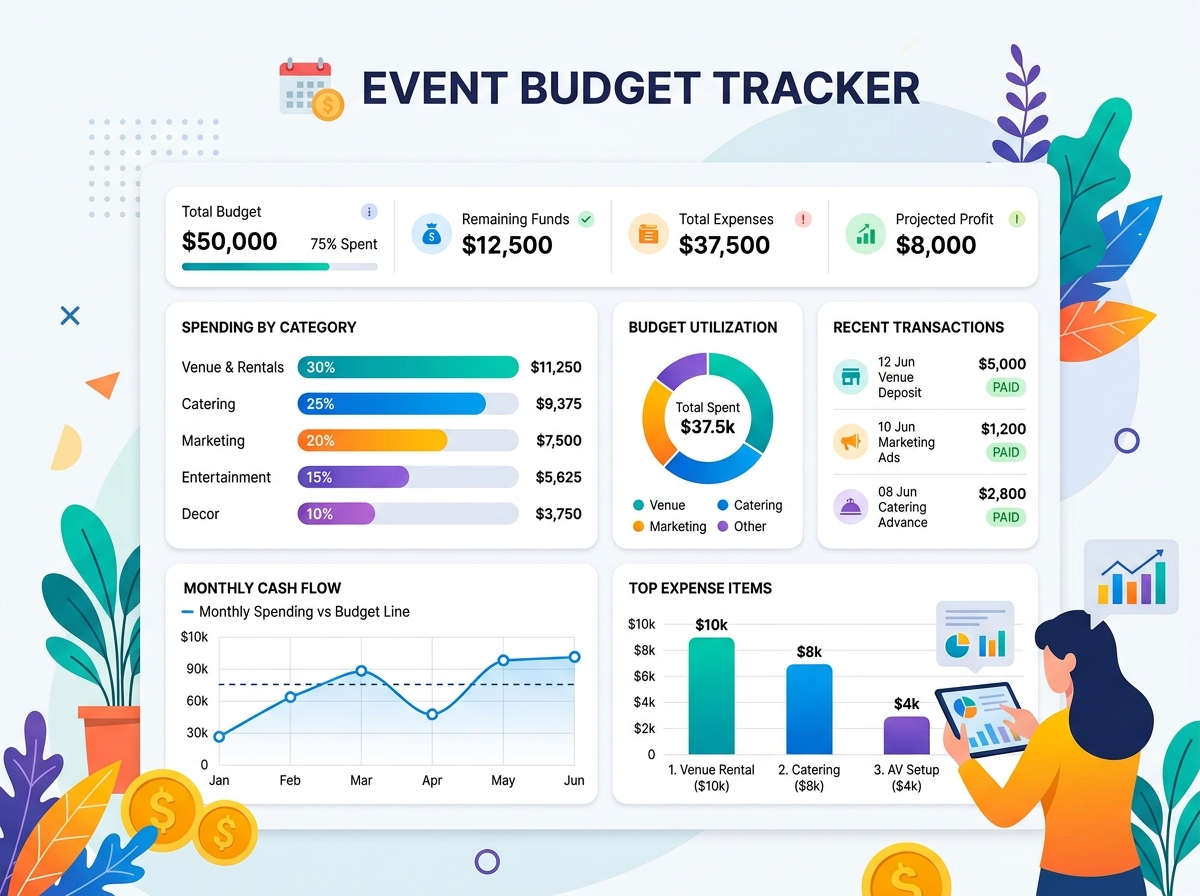
The template features side-by-side columns for Projected Cost, Actual Cost, and Variance. For every item—whether it is a keynote speaker fee or badge lanyards—the system calculates the exact difference. This real-time variance calculation allows you to immediately see which departments are over-budget, giving you the operational agility to adjust spending in other categories before it is too late.
Phase 2: Integrated Cash Flow Mapping
Event budgeting is not just about total numbers; it is about timing. Our template integrates a deposit tracker and payment schedule. By logging payment deadlines (such as venue deposits and vendor retainers) alongside projected registration revenue streams, you ensure your planning team always maintains a healthy cash flow, preventing pre-event credit deadlocks.
Proving Value: Translating Event Costs into Tangible ROI
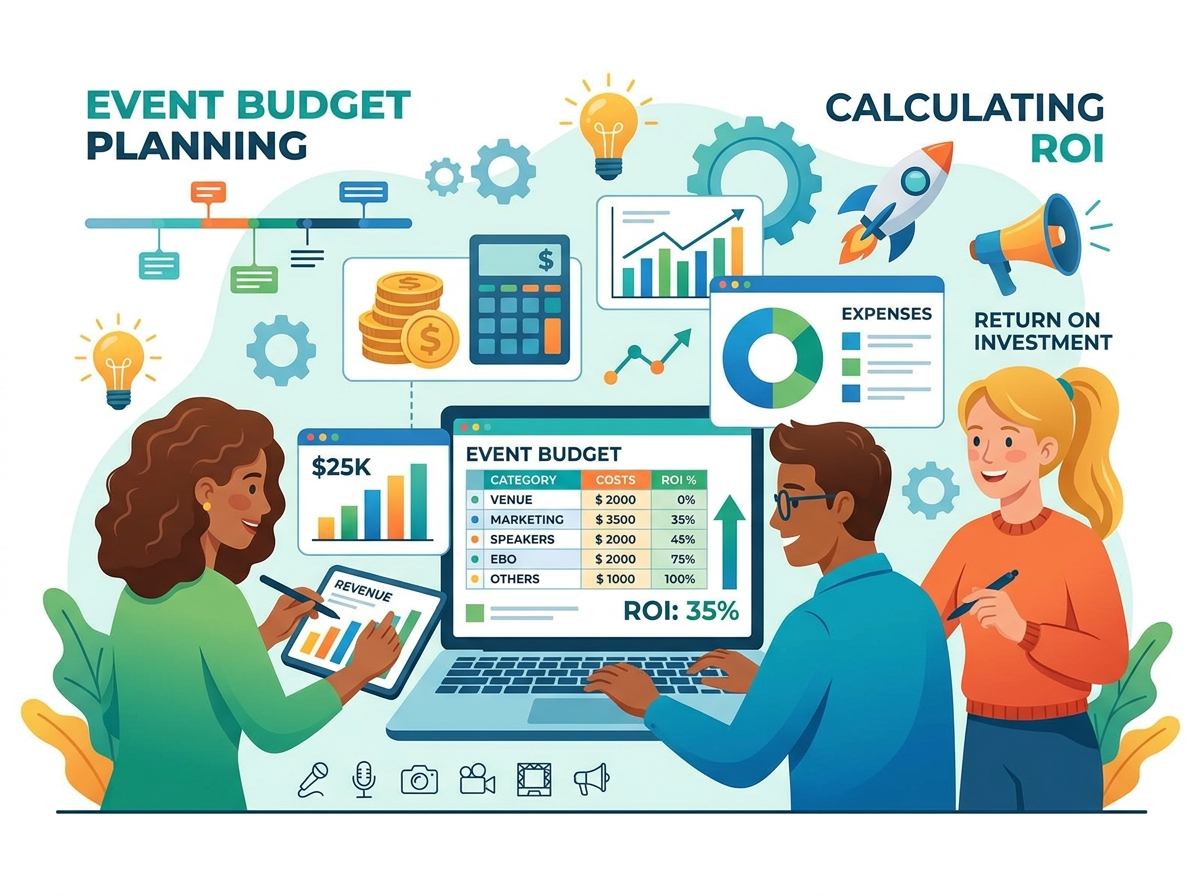
For corporate stakeholders and sponsors, a successful event is not just one that stays under budget; it is one that drives clear business outcomes. Proving event ROI requires a strategic transition from tracking raw cost lines to analyzing integrated conversion metrics. The ultimate corporate meeting template integrates an ROI calculator designed to track both hard and soft financial returns:
- Direct Revenue: Track ticket sales, exhibition booth bookings, and sponsorship packages directly against your operational expenses.
- Indirect Value (Lead Acquisition): For B2B events, the true value lies in the sales pipeline. By tracking the number of qualified leads captured on-site and assigning an industry-standard Customer Lifetime Value (LTV), you can demonstrate the exact pipeline generation value of your event.
- Attendee Retention and Lifetime Value: Standardizing pre-registration and post-event survey data helps quantify soft returns like brand advocacy, stakeholder alignment, and team retention rates, justifying the event’s strategic placement in the annual budget.
The Digital Leap: Streamlining Budgets and Registrations with EventHex
While a structured spreadsheet template is a massive upgrade over disorganized tracking, the ultimate level of financial control is achieved when your budget is natively connected to your event execution platform. This is where EventHex transforms corporate event management.
EventHex is an AI-first “Attendee Experience Suite” built to streamline the entire event lifecycle. By integrating EventHex’s premium, secure event registration pages into your workflow, you instantly capture clean, structured attendee data. Your ticketing tiers, discount codes, and sponsorship sales are processed securely, automatically populating your financial logs.
On-site, EventHex’s local print synchronization ensures lightning-fast, offline-safe badge printing, eliminating the paper waste and double-printing issues that typically bloat logistics costs. Meanwhile, organizers monitor live attendance, registration numbers, and revenue performance in real time from a single, unified centralized dashboard. By aligning attendee registration, check-ins, and financial tracking under one powerful system, EventHex gives your planning team the absolute visibility and operational control needed to execute high-impact corporate events smoothly, on-time, and within budget.
Conclusion
Upgrading from fragmented tracking to a standardized corporate event budget template is the single most effective action a planning team can take to protect their event ROI. By categorizing expenses, enforcing contingency reserves, and utilizing self-service ticketing platforms, you eliminate the copy-paste bottlenecks and version conflicts that plague trade shows and corporate meetings.
Take control of your event finances today. Streamline your workflows, impress your corporate stakeholders, and deliver a seamless, high-value experience that attendees and sponsors will want to return to year after year.
Frequently Asked Questions (FAQ)
What is the 10% contingency rule in event budgeting?
The 10% contingency rule states that event organizers should set aside a dedicated reserve fund equal to 10% of their total estimated budget. This fund must remain untouched during the planning phase and is used exclusively to cover unexpected on-site costs or logistical emergencies during the event.
How do you calculate corporate event ROI?
Corporate event ROI is calculated by comparing total financial value generated (direct ticket/sponsorship revenue, plus indirect value like on-site B2B leads captured multiplied by lead-to-customer conversion value) against the total cost of hosting the event. The formula is: (Total Event Value – Total Event Cost) / Total Event Cost x 100.
How does EventHex help control event budgets?
EventHex helps control budgets by combining event registration, secure payment processing, ticketing, and on-site badge printing under one unified system. This eliminates multi-platform software licensing fees, reduces manual copy-paste labor costs, and prevents costly on-site badge double-printing waste.